Unknown's avatar

About conjurors

I am a YA fantasy author who started this blog to share the unusual places I find inspiration for my writing, and to discuss with other artists how they find their muses. My first book of The Conjurors series, Into the Dark, is now available on Amazon.

The Art of Foreshadowing

“If in the first act you have hung a pistol on the wall, then in the following one it should be fired.” – Anton Chekov

shutterstock_90204550Being in the hands of a master of the craft of foreshadowing is one of the most rewarding parts of reading a great book. J.K. Rowling is such a master – there are incredible examples throughout the entire Harry Potter series. But by far my favorite is when we learn that Snape loved Harry’s mother in the final book of the series, Harry Potter and the Deathly Hallows. Rowling knew in book one that this was coming and laid clues throughout her series, from the color of Harry’s eyes to the hatred Snape had for Harry’s father, that made the payoff in book seven incredibly rewarding. It was one of those moments as an author where I shake my head and consider giving up the craft in the face of such genius.

Another example of excellent foreshadowing that I recently read is in Kendra C. Highley’s Matt Archer series. (I’ll be interviewing her in July, for those who would like to hear more.) I don’t want to give away any spoilers for those who haven’t read her latest book, but she had a creative idea that I haven’t seen before. Her character has a vision of himself with a strange marking, like a magical tattoo. It’s foreshadowing when he has the vision, then again when he gets the mark, because we know that he’ll be having some crazy adventures soon.

We all can’t be Rowling, but I do try to incorporate good foreshadowing into my writing – which invariably involves intense planning for my entire series, rather than planning book by book. This is my favorite part of the writing process – creating the overarching plot and identifying where the payoffs of each storyline will occur. It makes me feel like the master of my own little universe. For some great basic information and tips on foreshadowing I also like the advice in this All Write – Fiction Advice blog post.

But in the actual implementation of little clues throughout my series, I am constantly second guessing myself – are the hints too obvious, or too obtuse? It’s hard to find a balance between ‘It was a dark and stormy night’ and a little failed eye contact by a character at a key moment. What seems blatant to me as the author may be totally missed by an unsuspecting reader. So it’s critical that I have honest beta readers who can give me feedback.

Do you have any tips on how to implement foreshadowing well?

Author Interview: Jason Robbins

Jason RobbinsWhen I stumbled upon Jason Robbins’ post-apocalyptic fictional blog, Soulless, I planned to read a couple of entries out of curiosity because I haven’t had a lot of exposure to fictional blogs. Instead, I found myself following every step of his anti-hero’s journey. He has created a character who should be difficult to sympathize with, but somehow you can’t help rooting for. Add to that the mystery of what triggered the apocalypse and why there are any survivors at all, and you can understand why I ignored my toddler’s cries for milk for several minutes so I could finish reading the latest entry. After marathoning all of the blog entries in one sitting, I was interested in learning about Jason’s inspiration for Soulless and how he tackles the thorny writing challenges he encounters writing for this medium.

Tell us a little about yourself.

Well, I’m a native New Yorker.  Grew up in Queens and now I live in Manhattan.  I have a day job that I won’t bore you with. Suffice it to say, creativity isn’t a big part of it.  I’ve always loved writing, and this guy I worked with, who I’m good friends with now, was actually writing a novel on the side.  He always talked about it, seemed to derive a lot of joy from the process. So I thought, what the hell, let me take a stab.  Been writing fiction in one form or another ever since.  I love it.

What was your inspiration for your blog, Soulless?

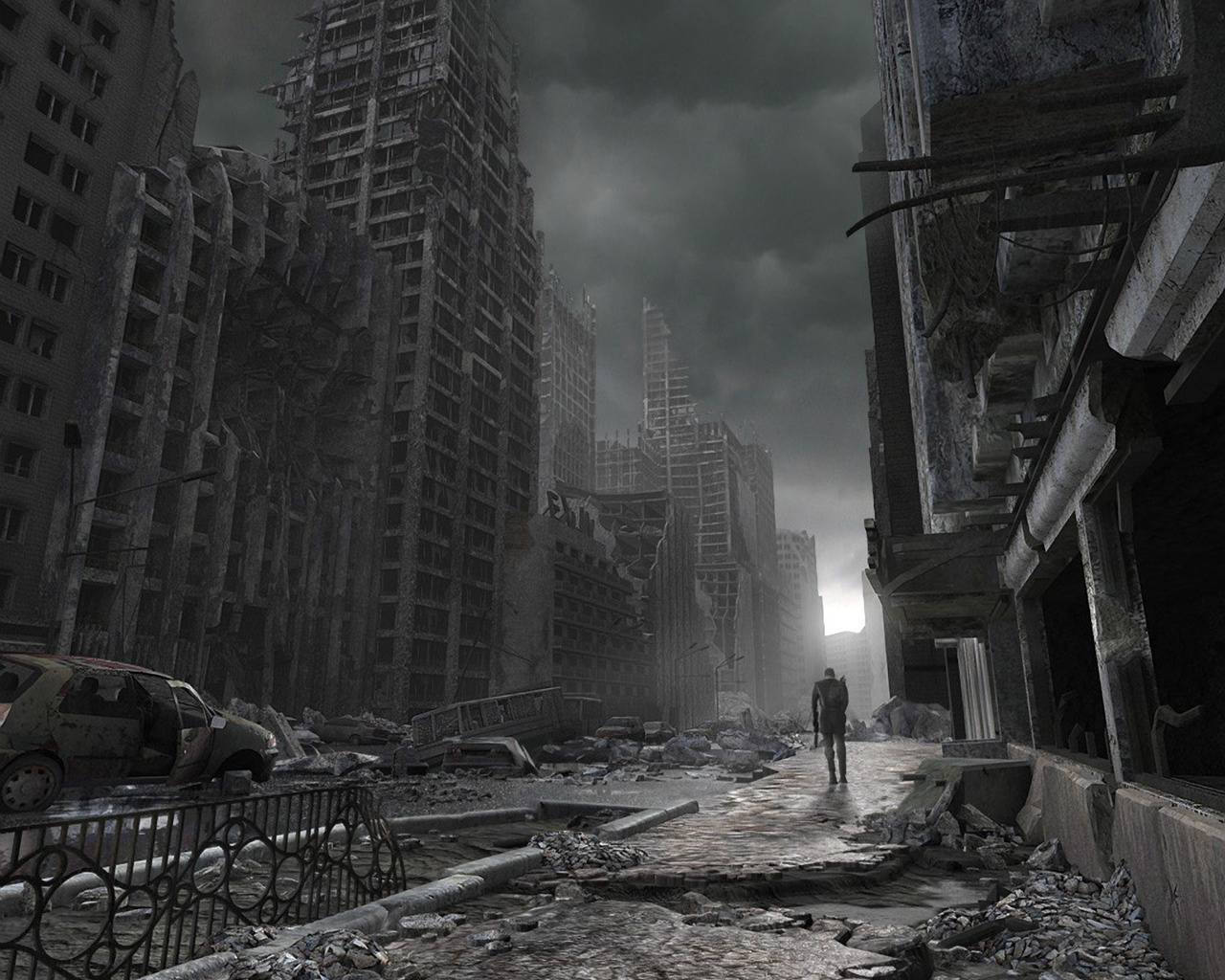
Apocalypse NYCI always wanted to write an apocalypse tale, but the market is so saturated with them now, I figured, what’s the point?  But then this idea hit me – What if the protagonist has no interest in saving humankind or propagating the species?  What if he actually, if only subconsciously, wished for the apocalypse?  What would that story look like?  I think all of us, in our darkest moments, have wished everyone would just disappear.  This story takes that mentality to the extreme.  I think it’s pretty interesting to see someone start like that and then grow into something more.

Where do you go for inspiration when you’re feeling blocked?

I don’t want to jinx myself, but I’ve never actually experienced writer’s block in the seriously debilitating sense of the term.  If anything, I have more ideas than I have time to devote to them.  But, when I’m in the middle of a story, and I’m not sure where to take the proceedings next, I usually let the characters do the work for me.  I think about what that character or someone I know like that character would do next.  What’s the next logical step that character would take?  It helps shape the story more organically than if you plan out a bunch of plot points and drag the characters kicking and screaming through them.

What’s the strangest thing that has ever inspired you?

It’s funny, I had started writing the first post for Soulless, and I was walking down the street – don’t really remember where I was headed – and I came upon this sign someone had put up against a work-fence.  You run into weird things all the time in New York; in this case, someone had scrawled “What if when you die, they ask how was heaven?” on a piece of cardboard and propped it up.  And there were people streaming by all around me, but it happened that no one was right in front of this thing, so I took a picture, and it really looked like the city had been abandoned and someone left this sign there.  And that’s how I came up with the idea for the Messenger, one of the major antagonists in Soulless, a killer that leaves cryptic religious messages around post-apocalyptic Manhattan.  I even posted the pic on the site as his first message.

Tell us about an inspirational figure in your life.

My little cousin Alexis is the inspiration for the character of Emily in Soulless.  She’s a bit older than Emily now, but she’s adorable, charismatic, smart as a whip, and a brilliant writer for her age.  I’m a flawed person, but whenever I’m around her and her brother, Jesse, I always strive to be the best version of me that I can be.  I figure if anyone could bring out the good in my protagonist, it would be someone like Alexis.

What are some words that you live by?

I think Van Wilder said it best when paraphrasing Elbert Hubbard: “You shouldn’t take life too seriously.  You’ll never get out of it alive.”   If you’re looking for some words to write by, you can’t go wrong with Alfred Hitchcock’s “Drama is life with the dull bits cut out.”  I always try to keep that in the back of my mind while writing, and it helps streamline the stories immensely.

Is there anything else you would like us to know?

Yes, if you have a writer in your life, be gentle.  It’s not easy putting yourself out there in front of family, friends and the public.  Your support can give them the courage to endure and to succeed.

Author Interview: K.N. Lee

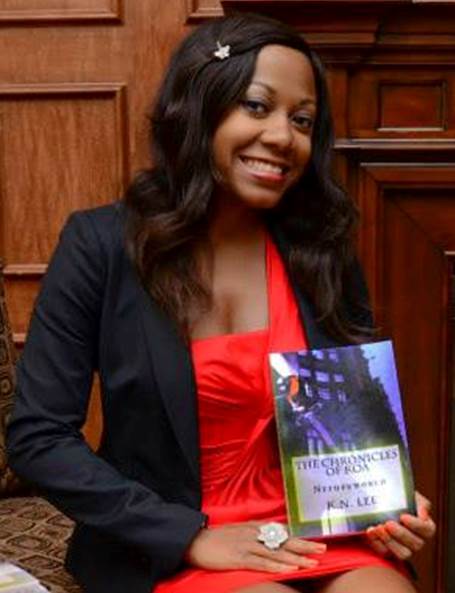
K.N. LeeThe first author in my new interview series is K.N. Lee, a talented up-and-coming young writer who has already self-published a novel, a book of short stories and a book of poetry. Her work, which is both creative and achieves a depth of emotion, is riveting. I’ll also admit that I’m drawn to her newest novel because it stars a strong female heroine who can take care of herself (and kick a little butt when the occasion calls for it, too). Clearly, she knows quite a bit about how to channel her muse.

Tell us a little about yourself.

I was born in Chicago, Illinois, raised in Atlanta, and currently live in Charlotte. I discovered my love for writing when I was in the second grade. Obsessed with books, I decided to create my own. I’d write a story, draw the pictures, and then cut up cardboard and wrap it in wall paper to make my book a hard back. It was the only thing I enjoyed. You’d have to force me to play outside. I just wanted to write!

What was your inspiration for your newly released novel, The Chronicles of Koa?

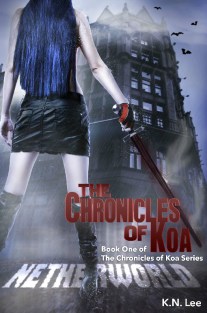
The Chronicles of KoaThe inspiration for Koa came from a nightmare that I had. Not only that, but I love characters that may look small and nonthreatening, but can indeed be the most dangerous person in the room. There are many factors that went into creating The Chronicles of Koa. I grew up an Anne Rice fan, and I fully believe that she has the best vampire lore. So, what did I do? I created my own version of vampire, completely re-imagined. I didn’t stop there. As a high-fantasy fan and writer, I also created my own creatures and classes. Syths, Scayors, War-Breeders, Jems…they add an unexpected element to the story. You’ve never heard of them before, so the intrigue is heightened in my story.

Where do you go for inspiration when you’re feeling blocked?

Whenever I’m feeling blocked, I do a variety of things. Sometimes I’ll take a nice long walk with my iPod and my dog. Other times, I’ll take a yoga class or play video games (believe it or not, but video games are excellent inspiration!) Above all, I always go back to my desk and simply…write. It may feel forced at times. You may feel like it is a chore, but for me, I usually end up surprised by what I come up with. That blocked feeling has been conquered!

What’s the strangest thing that has ever inspired you?

Umm…OK…here goes. I had an experience with what I feel was a ghost. I was a child, and as I look back at the experience, I am no longer sure what happened. All I know, is that something grabbed my leg when I was trying to fall asleep. That moment, as horrifying, and as quick as it happened, started a traumatizing period in my life. I didn’t tell anyone what happened for years, for fear that whatever had grabbed me might still be watching me, and might try again. So, I took that fear and used it to my advantage. In silence, I instilled that feeling of absolute terror and let my characters use it. Such a real emotion gave my characters life.

Tell us about an inspirational figure in your life.

Tolkien is such an inspiration. He showed us that you don’t have to recycle the same creatures that have been used for centuries, and created his own. I do this myself. I may use elves sometimes, or vampires, but I also create my own creatures. In Koa, you’ll learn about Jems, War-Breeders, etc. In my high-fantasy trilogy, Rise of the Flame, you’ll see Tryans. The power of creation is exactly why I love writing so much.

What are some words that you live by?

If you have to choose between a material good or an experience, always go with the experience. Don’t get me wrong, I love to shop! However, if I have a chance to travel, see a show, or hang out with friends, I’ll always pick the latter.

Is there anything else you would like us to know?

I suppose I would like everyone to know that even though I am always cheerful, bubbly, and giggly, there is a darker, more serious, side to me that fuels my stories. I don’t hold back in my writing, and I fear that I truly live through my characters. Who knows, pick up The Chronicles of Koa, Wicked Webs, or Thicker Than Blood on Amazon…I might just surprise you.

Calling All Authors – What Inspires You?

open book2One of the reasons that I started this blog was to learn how other authors and artists find inspiration. I want to hear about your journey to creating your masterpiece – what got you started and what keeps pushing you forward. To that end, I’m inviting any authors who would like to be interviewed on my blog to contact me using the form below.

← Back

Thank you for your response. ✨

Adapting The Hero’s Journey for a Heroine

Heroesjourney_svgThe hero’s journey (also called the monomyth), outlined by Joseph Campbell in The Hero with a Thousand Faces, identifies common elements in stories from around the world, particularly myths and quest tales. I’ve been fascinated with the concepts Campbell defined since I first encountered his book, and I immediately wondered how it could be adapted for a heroine.

It has been pointed out by others (Maureen Murdock’s book The Heroine’s Journey and an awesome blog post on the FANgirl blog, for example) that the outline of the hero’s journey is inherently sexist. While I don’t dispute the truth of that argument, as a writer I’m less concerned with analyzing the pattern outlined by Campbell and more interested in how it can make my own stories richer. Being too strict in following each step in a particular order can stifle any good book, and in particular with a heroine, it’s critical to be flexible and adapt this outline to maximize its effectiveness.

Campbell’s pattern is split into three pieces, each with sub steps – the departure, initiation and return. I have found with The Conjurors series that it is helpful to have these three elements as a basic outline for each book as well as the series as a whole. It helps me to keep my thoughts organized and to keep the adventure exciting. Below I walk through how each of these steps can work for a heroine, including examples of modern young adult fantasy heroines who have walked the walk.

The first section, Departure, has five subsections:

The Call to Adventure
The moment when the heroine discovers that something exciting is in store for her is one of my favorite moments to write. Suddenly her world expands and the possibilities seem endless. A great example of a heroine’s call to adventure is in The Scorpio Races by Maggie Stiefvater, when Puck Connolly realizes that one way to earn the money she needs to support her family is join the incredibly dangerous Scorpio Races as the first girl to ever compete.

Refusal of the Call
As tempting as the new adventure may be, the heroine usually doubts her ability or desire to embark on the incredible journey. This can be an especially powerful step for heroines, who may have more insecurities or a greater sense of duty to parents or even their own children than male heroes. Veronica Roth does a great job with this in Divergent. In this novel, society splits everyone into different factions based on a different virtue. Tris was raised in Abnegation (where everyone is selfless) but has the opportunity to join the Dauntless community (where bravery is cultivated). Leaving her life and family behind is an incredibly difficult choice, and makes the stakes high for her when she takes the leap into a new life.

Supernatural Aid
Of course, there would be no story if the heroine didn’t ultimately accept the adventure thrust upon her. Once she does, there is usually a guide or mentor who gives her advice and help – sometimes even an object that can be used to help her on her quest. Coming up with creative talismans and mentors for a heroine can be incredibly fun. In Amanda Hocking’s Trylle Trilogy, the mentor, Finn Holmes, is also the heroine’s love interest. The dynamic changes between them from as the series progresses so that they are on more equal footing, but early  in the series he is her guide into a new world of magic where she will be a leader.

silhouette2The Crossing of the First Threshold
This is the moment when the heroine leaves the known for the unknown. She leaves behind who she was to embrace who she could be. In Divergent, Tris literally takes a leap of faith and jumps off of a moving train onto a roof, and then off the roof into a hole. She doesn’t know what’s down there, but she knows she’s leaving her old life behind for a new adventure.

Belly of The Whale
Now officially on her quest, the heroine gets her first taste of the danger that she will be facing. Often this can be a threat or a fight that really shows her what her limitations are. We know Katniss is really in the belly of the whale in Suzanne Collins’ Hunger Games when she enters the arena and all of the competitors begin killing each other as they fight for a pile of food and weapons on the first day of the games. She narrowly escapes being killed herself, and the survival of the fittest begins.

The second section, Initiation, has six subsections:

shutterstock_136940549The Road of Trials
All heroines must undergo trials to prove they are worthy of their quest, and also to get them ready for the journey ahead of them. These tests can be physical tasks, but often they have a deeper meaning for the character and help develop them into a stronger person emotionally as well. In Lauren Oliver’s trilogy, beginning with Delirium, she does a creative job of the road of trials for her heroine, Lena. Lena doesn’t have to face physical tests, but rather emotional trials to open her up to the possibility that love is not a disease, as she has been raised to believe. She opens herself up to friendship and ultimately love, making herself vulnerable and sharing her past and present feelings.

The Meeting With the Goddess
Several of the steps in the Initiation section are particularly geared toward male protagonists, beginning with the meeting with the goddess. This is traditionally about a hero finding the unconditional love of a woman who is worthy to be his companion. But for a heroine, this step can be abstracted, which in my opinion makes it more interesting. The importance of this step is about the heroine realizing the importance of finding a love that is the ultimate inspiration for her adventure. Whether it’s romantic or platonic, it can be the beating heart of story. P.C. and Kristin Cast also used this step in a very different capacity in their House of Night series. The heroine, Zoey, has a literal encounter with the goddess Nyx, who identifies her as special. It is her first clue that she will be different from other vampyres and has an important destiny to fulfill.

Woman as Temptress
This can be a very frustrating step if you take it too literally. For traditional heroes, there will typically be a woman who tempts him to abandon his quest for her, or distracts him from what’s really important. But for the heroine, it doesn’t need to be a man (or woman) or even a sexual distraction. To me, this element is about tempting your heroine to take the easy way out. For Rose in Richelle Mead’s Vampire Academy, she is tempted a number of times. First, she is tempted to have a relationship with Dimitri, even though it would be a major distraction from protecting her best friend. Later, when Dimitri is turned into an evil vampire called Strigoi, she is tempted to abandon her duty to kill him and love him instead.

Atonement with the Father
This is another step that needs some serious reconstruction for a heroine. I think of this step as the heroine’s confrontation with someone who has a lot of power over her. It is time to fight that person and cast of the shackles. Sometimes it can be the big battle with the major villain of the series, but it can also be the person who makes the heroine doubt herself. In Kristin Cashore’s Graceling, for example, Katsa, who is gifted with the ability to fight to survive, has been working as her uncle’s thug, killing off his enemies. He manipulates and uses her from a young age, and when she finally announces that she is done doing his bidding by detailing how she would kill every single one of his guards if they all tried to stop her at once, I felt like cheering.

shutterstock_136883615Apotheosis
The heroine always has a divine moment separate from her adventure that is a turning point for her. Sometimes it is a brush with death, and other times it is having a moment of peace and clarity where she can regroup and prepare for the final leg of her adventure. Madeleine L’Engle does a great job of doing both with her heroine, Meg, toward the end of A Wrinkle in Time. Meg is nearly killed and left paralyzed when she travels through the Black Thing that represents evil. But her paralysis is cured by a gentle creature she calls “Aunt Beast” who allows Meg to find both physical and mental peace. She needs this moment of emotional stability to face the ultimate evil and rescue her brother from it.

The Ultimate Boon
After facing her demons and conquering the villain, the heroine is rewarded for what she has achieved. For Campbell, this is usually an item or piece of knowledge that his hero is meant to bring back to the rest of humanity. But in modernizing this step for a heroine, the ultimate boon can be the achievement of their heart’s desire, such as love or a new confidence. At the end of Melissa Marr’s Wicked Lovely, Aislinn becomes the Summer Queen after facing her greatest fear – becoming fey (fairies), which she has always believed are evil. Ultimately, she risks exile to save a group she has always hated because she knows it is the right thing to do.

The final section, Return, also has six subsections:

Refusal of the Return
After the journey is over, it is natural for the heroine to not be able to imagine returning to regular life. There is a resistance to abandoning the quest even after it is complete. Despite the reluctance with which she started , now she doesn’t want to accept its end. A wonderful example of a refusal to return is in the first of the Thursday Next series by Jasper Fforde, The Eyre Affair. The heroine, Thursday, is pulled into the novel Jane Eyre, where she has to protect the characters from being hurt or killed. But understandably, she loves the story and admires the hero, Mr. Rochester, and even though she knows her return to the real world is necessary and inevitable, she can’t help feeling a pull to the characters she has grown to care about even more than she already did to begin with.

The Magic Flight
Even after the heroine realizes that she must return to reality, the adventure isn’t completely over. The return trip usually includes a few final surprises for the heroine. Marie Lu does an amazing job of the flight in the first of her trilogy, Legend. The heroine, June, has already realized that the boy she thought killed her brother is actually innocent (and she is falling in love with him). Her realization and change of heart is the true climax of the book, but helping him escape is an awesome final adventure as they outwit guards and barely escape after a thrilling chase. Her story isn’t fantasy, so it isn’t a magic flight, but it does an excellent job of adapting this step for a modern heroine.

Rescue from Without
An adventure of this magnitude has to have consequences. Despite her victory, an emotional or physical toll was taken on the heroine. She isn’t able to recuperate on her own. At the end of The Hunger Games trilogy, Katniss is almost insane from all of the horror she has witnessed and her grief over losing her sister. But with the help of Peeta, her true love, she is able to reclaim her mind and live her life. The tragedy of what she has experienced doesn’t vanish, but she is able to find some measure of happiness again.

The Crossing of the Return Threshold
Every great adventure must come to an end. But for the heroine, she has been changed, and her return to life as she knows it means bringing with her the knowledge she has gained on her journey. Philip Pullman has a powerful moment of crossing the return threshold for his heroine, Lyra, at the conclusion of the His Dark Materials trilogy. In the context of the story, there are many parallel worlds that are connected by windows. At the end of the story, these windows must all be closed between the different worlds. Lyra and the boy she loves, Will, come from different worlds and must each return to their own in order to live full lives. As a result, when Lyra returns to her world, she is leaving behind the love of her life. It is at once empowering and heartbreaking.

shutterstock_58598566Master of Two Worlds
At the end of the quest the heroine has found a new balance in her life. It may be abstract – a better grasp of how to balance conflicting elements in her life. Or it can be literal, where the heroine is part of both the world she started in at the beginning of her journey as well as the new world that she explored on her adventure. Aislinn in Wicked Lovely is also a great example of being a master of two worlds. She has one foot in the mortal world, and the other with the fey as queen of the summer court. This means balancing her mortal friends and boyfriend (never mind school) with her duties to protect her people. It is a complex opportunity and challenge rolled into one.

Freedom to Live
At the end of the adventure, the heroine is fundamentally changed. She has a confidence in herself and her abilities, and is at peace with the trials she has gone through. She now has the freedom to live and enjoy her life. Katsa in Graceling chooses to live in the woods with the love of her life and ignore the rest of the world. Rose in Vampire Academy is no longer bonded to her friend Lissa, so she can live her own life with her soul mate. Katniss in the Hunger Games has finally left behind the brutality of life before the revolution that she inspired and can have a life and love of her own.

Some of these sections are more difficult to adapt for a heroine than others. I allow myself to ignore certain elements as it suits the story, or radically change them in other cases. Ultimately this is a tool to help you think of new ideas and complications that can make your story more interesting.

Have you ever used the Hero’s Journey as a model for your story? If so, how did it work out for you?

Jumping into the Rabbit Hole

Alice_in_WonderlandSince I was a kid, I have always been drawn to the story of Lewis Carroll’s (whose real name was Charles Lutwidge Dodgson) Alice’s Adventures in Wonderland. The idea that you could be walking along in a completely ordinary world, and then fall down a hole into an extraordinary one, is mesmerizing.

At night when I can’t fall asleep, I imagine myself falling through Alice’s rabbit hole. As I drop, images flash through my mind of whatever my semi-conscious mind can dream up. Sometimes I find answers to problems in my life or in my writing, and sometimes I am just lulled to sleep by a cascade of pictures that eventually blurs together.

My favorite thing about Alice in Wonderland is Alice herself. One of her defining characteristics is her curiosity, a value that leads her down exciting paths. She isn’t afraid to say yes to something new, and as a result she meets bizarre people and explores strange lands. I have tried to imbue this quality into Valerie, the heroine of The Conjurors, and let her curiosity lead her where it will.

P3240097The real-life inspiration for Valerie is my sister, Cheryl. She has Alice’s curiosity but more brains. Some say that writers create idealized versions of themselves in their main characters, but I realized after finishing the first book in the series that I had unconsciously modeled Valerie’s personality on the most adventurous, fun, compassionate person I know. Her fans call her “Cheryl the Explorer” because she embraces traveling the world and learning about new cultures. She takes smart risks with her life and doesn’t accept the status quo. But best of all, she is kind. She’s someone who will give you the shirt off her back and has a moral compass that always points true north. I just hope Valerie can live up to the person who inspired her.

Read It and Weep (Literally)

shutterstock_102844172This week I killed off my first character, ever. It was difficult – even though I wasn’t super attached to him, I couldn’t help feeling a little guilty. After all, he was a good guy and under different circumstances maybe he could have lasted for another chapter or two. But after reminding myself that he was, in fact, a figment of my imagination, I was able to focus on the most important part. How to make his death compelling.

What is it that makes death truly gripping in great young adult fantasy writing? I remember crying when Sirius Black and Dumbledore died while reading J.K. Rowling‘s Harry Potter series. And little Prim got a sniffle or two when I read Suzanne CollinsHunger Games trilogy. But I wasn’t sad so much because the characters were gone, but rather because of the emotional toll it took on Harry and Katniss. It was their response that sparked the reaction in me.

Gandalf‘s death in J. R. R. Tolkien‘s The Lord of the Rings, however, didn’t move me in the same way. He was my favorite character in the series, but when he died I felt more like shrugging than crying. Maybe it was his age. Maybe it was because he died a victor and had led a full life. Of course, then he returns as Gandalf the White, and as happy as I was to see him, I was glad I hadn’t wasted any time grieving for him. So it’s safe to say that you won’t find any of my characters coming back from the grave.

As a reader, I like when an author isn’t afraid to kill off main characters. It makes me feel like no one is safe, which heightens the tension during the action scenes. Now I just have to work on writing the emotion of these moments well.

Do you have any suggestions about things to consider for writing about death in young adult fantasy?

7 New Studies on How to Boost Creativity

shutterstock_49582234I don’t know about other writers, but when I hit a mental block, I’ll try just about anything to get past it. And I’m willing to admit that I’m not above looking for an easy answer. After all, if I can get a boost of creativity with minimal effort, there’s no shame in that, right? For fun, I did a little research on what the latest information is out there on how to find some inspiration when you’re stuck in a fit of doldrums.

1) Make Time to Daydream

Consider it an early Christmas present. I found several studies saying that daydreaming can increase creativity, including a study by the University of California, Santa Barbara, which promises that letting your mind wander helps your problem solving skills, and another by the University of Central Lancashire specifically encourages daydreaming at work to boost creativity.

2) Take a Shot of Vodka

I’ve been looking for an excuse, and now I have one. Alcohol does, in fact, encourage creativity. A 2012 study at the University of Illinois showed that having a blood alcohol level of .075 (a couple glasses of wine) increased people’s ability to solve problems and have sudden insights more quickly. Of course, the benefit doesn’t stick if you’re smashed. But for the sake of science (and solving my current plot puzzle), I’ll drink to this one. Check out more details this article in Psychology Today.

3) Think Negative

This one surprised me. We’re always told to think of the glass as half full, but a 2013 study in the Academy of Management journal suggests just the opposite. That’s not to say that a positive attitude doesn’t have many benefits on a daily basis, and certainly people can be upbeat and innovative. But the flip side is that people are even more creative when they are feeling negative and then channel it into something positive. The jump from negativity to positivity increases the chance of tapping into big inspiration.

4) Look at Something Green

shutterstock_116604139I knew there was a reason that this is my favorite color! A recent article in Prevention discussed how people exposed to the color green scored higher on a creativity test than any other color.

5) Reconnect with Nature

While you’re looking for something green, you might as well step outdoors. This one comes as no surprise to most of us, but now there’s proof. According to an article by the University of Utah, going for long hikes and being disconnected from the daily bustle yields big benefits for the creative process – people scored 50% higher on a creativity test after spending four days outdoors.

6) Think Like a Lefty

After a lot of controversy, scientists are beginning to agree that activiating the right side of your brain increases creativity. According to a recent article in Psychology Today, one easy way to do that is to squeeze your left hand into a fist (because using the left side of your body activates the right side of your brain). The right side of your brain will light up, and you’ll feel a boost of inspiration.

7) Send Electricity Through Your Brain

shutterstock_132908159Here’s where we separte the boys from the men. I mean, who wouldn’t have a glass of wine or go for a stroll outside for a little inspiration? But it takes guts (or desperation) to hook electrodes to your head and send a jolt of electricity to your brain. But if you’ve reached the point where you’ll try anything, this really works. According to an article in the Atlantic Monthly, a recent study at the University of Pennsylvania showed that people were much more inventive when it came to coming up with unusual ideas after passing a weak electrical current through their brains.

Now to start on my next blog post, 5 easy ways to stop procrastinating and get back to writing 100,000 words in 100 days…

What’s Your Writing Research Style?

DaVinciCodeA few years ago, when I read The DaVinci Code by Dan Brown, I was struck by how the depth of his research made his story so appealing. He had obviously deeply studied the legends around the historical buildings and objects he mentioned, as well as their recorded history. And when Robert Langdon found something new in these famous objects that millions of eyes had viewed but never noticed, I felt a tangible thrill of discovery. It reminded me of reading Nancy Drew when I was younger – it felt like an adventure that anyone could stumble upon, like secret passages are around every corner and the world is a mysterious, exciting place.

stonehengePlaces with history are particularly fascinating to me. Whether it’s more myth than reality, like the legend of Atlantis, or real-life architectural marvels, like the Great Pyramid, I find myself researching everything I can on these topics. When I included the Great Pyramid and Stonehenge in my first novel of The Conjurors series, I rented videos from the library, scoured the Internet, and even interviewed friends who had visited the monuments. I learned a ton of information that I never used when I wrote my book, but a few intriguing details sparked my imagination and made my story much richer.

I’m deep in the midst of writing the second book, and I feel almost guilty that I’m not taking the same amount of time to do research on the places I’m writing about. Instead I’m relying on my imagination and a setting that best suits the plot I’m writing about, rather than embedding the story in actual facts or legends. I’m happy with what I’ve written so far, but it has me second-guessing myself. Am I taking the easy way out? Should I return to my research roots? Or is it okay to let my imagination take the lead this time?

100,000 Words in 100 Days

shutterstock_77716045Lately I’ve been fighting with myself. There are so many excuses not to write every day – I have a toddler with a virus every other week, a demanding day job, and family and friends that I want to spend time with. At the end of the day I’m so tired that I feel like eking out an ounce of creativity would be like squeezing water from a rock.

But on the other hand, I’m a happier person when I write. Suddenly on my commute to work instead of being annoyed with the traffic, I’m imagining scenes that I’m working on. I feel more attuned to what’s going on around me, because I never know where inspiration might strike. And when I wake up in the middle of the night, instead of stressing about a deadline the next day, it’s because I just solved an important plot puzzle that had been nagging me.

I’ve always been a person who likes to have a solid goal, so I’ve made the decision that I will write every day, no excuses, for 100 days. With some luck, I hope to have a very rough first draft of the second book in my series completed at the end of that time. Hopefully at the end I’ll have something solid that I can edit, and my sanity will still be intact. Wish me luck.