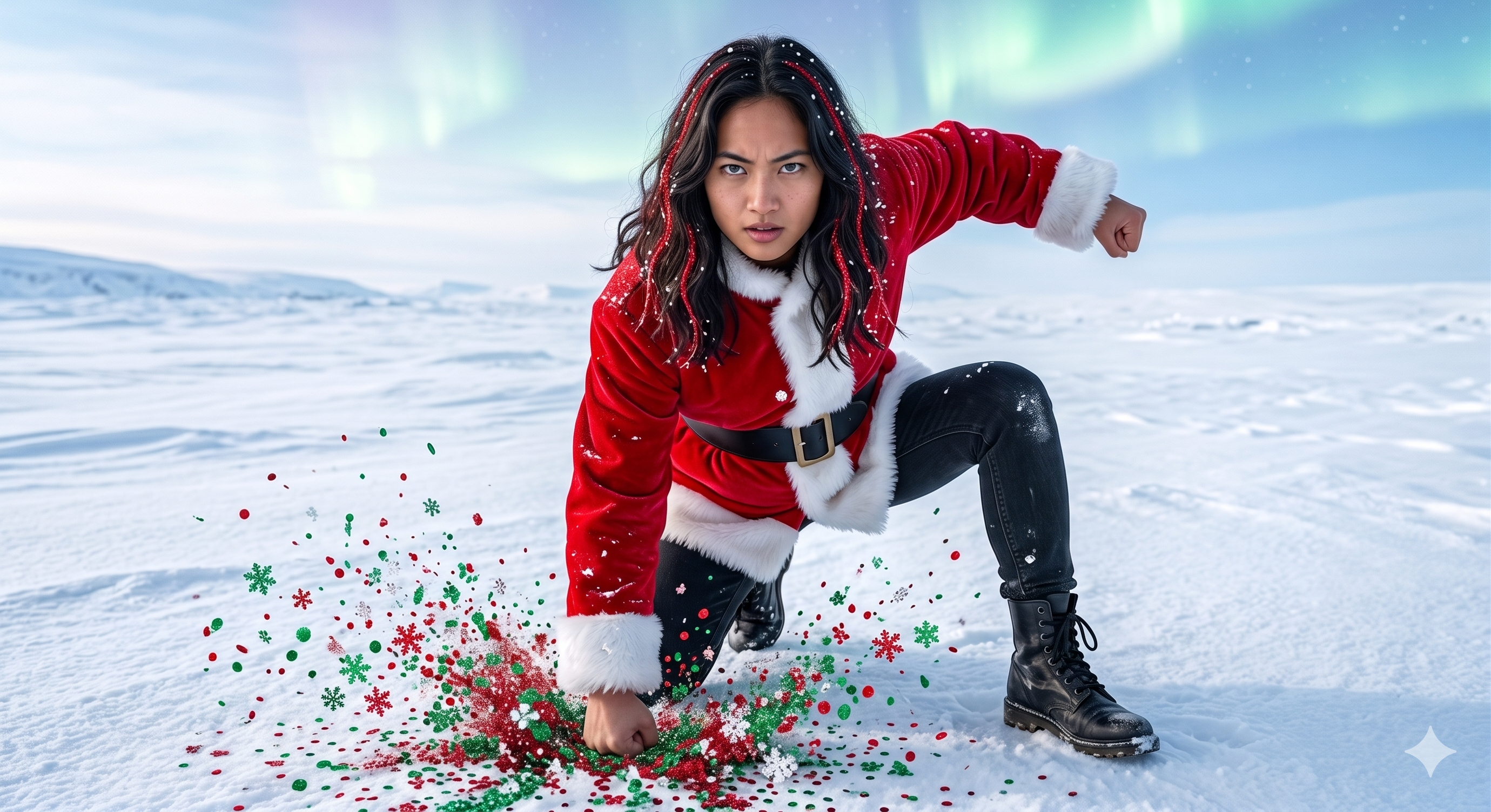
As writers, we spend months or even years living with characters entirely inside our own heads. We know exactly how the light catches their eyes, what their hometown looks like at dusk, and the exact smirk they give right before doing something reckless. Translating that vision into text can sometimes feel like trying to explain a dream.
Lately, I have found a new way to bring my stories to life in my own mind even more vividly. I started using AI image generation to visualize the characters and scenes I’m currently drafting.
To be clear, I am not generating these images to use as final book covers or interior novel illustrations. This is simply a creative tool. It inspires me during the drafting process and helps me lock down my world building. Most importantly, it gives my readers a direct peek into the world exactly as I see it.
Right now, I am deep into the development of Super Santa, a superhero spoof novel. I wanted to share a few of the hyperrealistic images I have created for the project and give you a breakdown of how to generate consistent, repeatable character models to inspire your own writing.
A sneak peek at the Super Santa universe
Because this project leans heavily into superhero tropes, the visuals needed to carry a cinematic, blockbuster weight. I also spoofed famous images from other superhero movies. I focused on hyperrealistic image and video generation to capture the grit, the action, and the very specific aesthetic of a Santa-themed hero.


How to create a repeatable AI character model
If you want to use AI to visualize your protagonist, you have likely hit the biggest roadblock. It is easy to generate a beautiful character once, but it feels impossible to get the AI to recreate that exact same face again.
If you want to build a consistent visual reference board for your novel, you need character consistency. Here is how you build a repeatable model.
- Write a master character prompt. Do not just type “a man in a superhero suit.” You need to lock down the exact facial architecture. Write a master prompt that includes highly specific descriptors like jawline shape, exact eye color, skin texture, age, hair parting, and specific blemishes or scars. Use this exact text every time.
- Embrace imperfections. Real humans are not perfectly smooth. To avoid the plastic AI look, add prompts for skin texture, visible pores, slight asymmetrical features, or environmental weathering like dirt, sweat, or windblown hair.
- Establish a base uniform. Keep their clothing consistent in your prompts. If your protagonist wears a specific style of armor or a signature jacket, describe it exactly the same way in every single generation.
- Utilize character reference features. Most advanced AI tools now have a character reference parameter or a way to upload a base image. Feed your absolute best and most accurate generated image back into the system to force the AI to use it as the blueprint for all future generations.
Tips for getting hyperrealistic results
Getting your character to look the same is step one. Getting them to look like a living, breathing person instead of a plastic doll is step two. To get those stunning, hyperrealistic results to share with your readers, you have to prompt the AI like a film director.
- Use photography terminology. Instead of simply asking the generator to make it look real, use specific camera directions. Add terms like 50mm lens, shallow depth of field, cinematic lighting, 8k resolution, volumetric fog, or shot on 35mm film. Don’t know this terminology? Don’t worry, you can ask AI to create the prompt for you, explaining what you’re looking for.
- Control the lighting. Lighting dictates the mood of your scene. Specify golden hour lighting, harsh neon studio lights, dramatic shadows, or soft ambient glow depending on the tone of your chapter.
- Leverage background reference images. Finding the perfect setting can be tricky. If you have an image with the exact environment you want, you can upload it to use purely as a background reference. Many AI platforms have an inpainting tool or image to image feature that lets you mask out the original person in the photo and replace them directly with your own character model.
Visualizing your novel is an incredible way to keep yourself motivated during the drafting process and to build excitement with your readers. Have fun playing the role of casting director, set designer, and lead photographer for your own universe.

Leave a Reply