Step inside The Conjurors Series with an Animal Crossing New Horizons island tour

World building is my favorite part of writing fantasy. When I first outlined The Conjurors series, I wanted a setting totally disconnected from our reality. That is exactly how The Globe was born. It is a magical land tucked away in the center of a black hole where the rules of physics give way to pure magic.

Because this world is so unique, I thought a lot about classic video games when I created it. Games almost always have distinct landscapes like an ice world, a desert world, or a water world. I built that exact concept directly into the lore of the books to make exploring The Globe feel like advancing through levels.

For those who have never played it, Animal Crossing: New Horizons is a popular Nintendo Switch video game where players are given a deserted island to completely customize. You can build cliffs, dig rivers, and decorate inside and outside to design your own perfect world. Translating The Globe into this game felt like a perfect fit because my books already shared DNA with video game maps.

I spent the last few months physically mapping out the land. I designed the layout to be a sequential journey. If you follow the path, you will walk through the first book of The Conjurors Series, The Society of Imaginary Friends, in the exact order Valerie does.

Walking the story beats

Your journey starts the moment you leave the airport. You land right in Arden. I wanted to capture the feeling of a deeply magical forest, so I used the game’s glowing moss and mushroom items to surround you with the vibrant magic of the Society. If you want to try making your own, check out this guide on how to build a magical forest in ACNH.

As you follow the path forward, you will catch a quick sneak peek of Plymouth, the underground city beneath Arden. The camera angle in the game is usually fixed, so I used a design trick called forced perspective here. By placing smaller items on cliffs far away, it creates an optical illusion that makes looking down at Plymouth seem like a peek underground. Here is a great tutorial on forced perspective if you want to see how the illusion works.

Next, you can explore the colorful, horseshoe-shaped path at the heart of Arden (right above Plymouth), which has the biggest of the guilds on the Globe, including The Society of Imaginary Friends, Knights of Light, and Guardians of the Boundary. They are all decorated inside and out! From there, you get to travel by rollercoaster straight into the desert. You all know how much I love rollercoasters in real life, so building this was one of the most rewarding parts of the game.

You then continue your journey into the futuristic city of Messina. In front is a suburban neighborhood, but behind it visitors can see the city skyline. To bring this area to life, I used glowing servers and neon lights. You can watch this how-to video on building city skylines to see the creative process.

Next comes my favorite interactive part of the island tour. The game features special warp pipes that instantly teleport your character across the map. I used one of these to represent the Where-O-Well Valerie jumps in to escape her enemies. You jump in, and the pipe transports you directly to Elsinore. This area is a pure ice world. I used the game’s frozen ice block items to build a massive, shimmering ice castle.

Finally, the terrain shifts. You move from Elsinore to the bleak, purple land of Dunsinane, where the atmosphere grows heavy. This is where the final battle takes place at the Black Castle. If you go inside and find the dungeon, you’ll even find the sword Cyrus infused with light from a glowing flower.

Experience the world of The Conjurors in a whole new way

If you have a copy of the game, you can visit the island right now. Just hop into a bed, go to sleep, and enter the dream address below.

Dream Address: DA-5087-9288-3488

If you have not started The Conjurors series yet, now is the perfect time. You can grab a free copy of book one, The Society of Imaginary Friends, and walk through the island as you read along with Valerie’s journey.

I would absolutely love to see your characters exploring the desert or braving the dungeons of the Black Castle. Please take pictures if you visit and tag me so I can see them. Thank you for always supporting this series and letting me share these creative side projects with you.

Happy traveling!

Decoding fiction age categories from middle grade to adult

I spend a lot of time reading across the entire sci-fi and fantasy spectrum, bouncing from middle grade adventures to sprawling adult space operas depending on my mood. But as an author, I know firsthand that pinning down exactly where a manuscript fits can be a headache.

When I sit down to draft, the boundaries between Middle Grade, Young Adult, New Adult, and Adult fiction aren’t always clear-cut. Does a middle grade adventure lose its classification if the emotional stakes get too dark? If a YA protagonist is tackling intense, systemic rebellion, does that bump the book into New Adult territory?

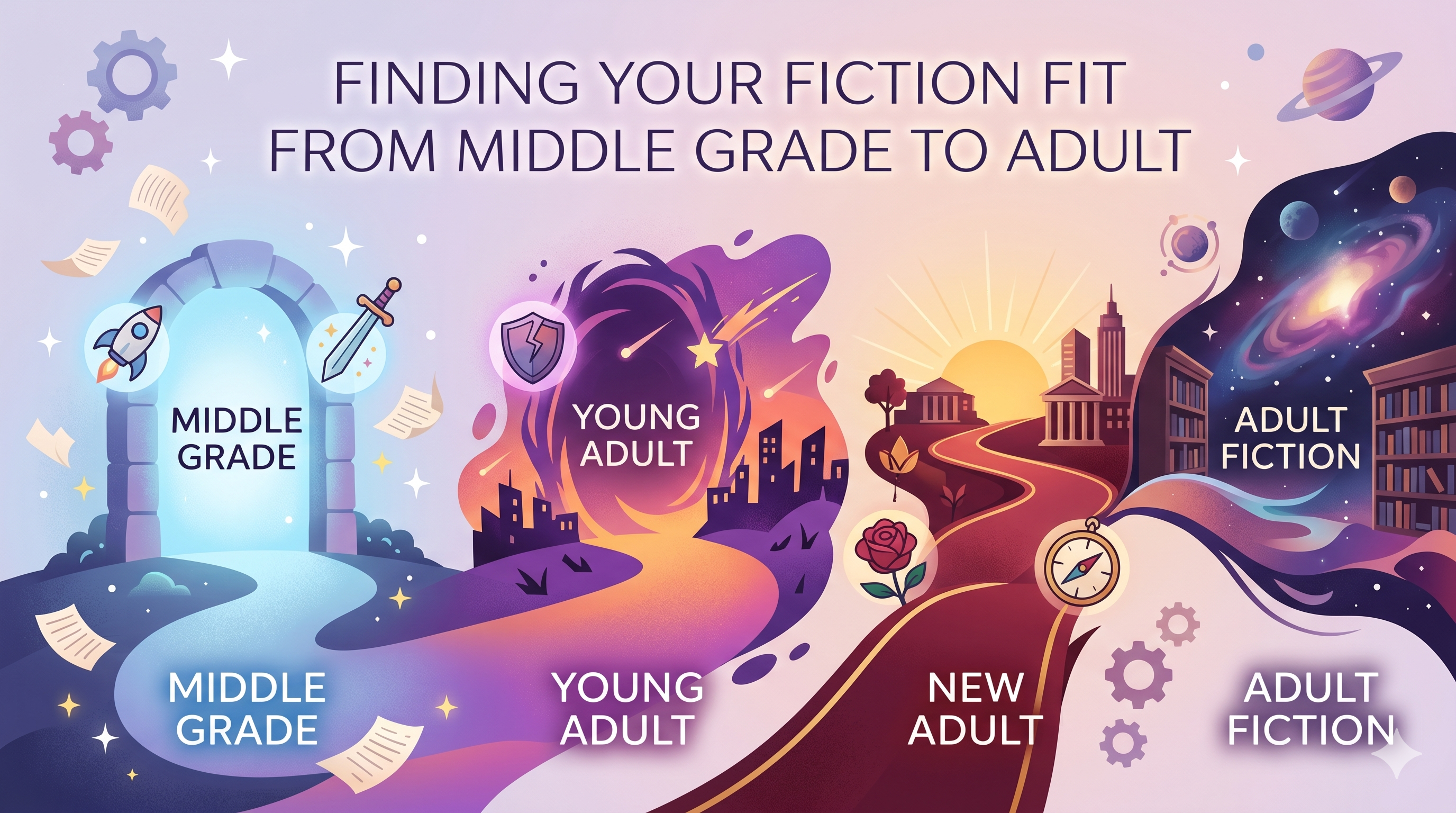
Whether you’re a reader trying to find the right maturity level and pacing for your weekend binge, or a fellow writer trying to figure out how to pitch your current work-in-progress to an agent, knowing the industry standards is crucial. Ultimately, the differences between these categories come down to four main pillars: the age of the protagonist, the thematic focus, the target word count, and the level of mature content allowed on the page.

Here is a breakdown of what makes each age category unique, what readers expect, and what we need to keep in mind as writers.

Middle Grade (MG)

The target audience: Readers aged 8 to 12.

The protagonist: Usually between 10 and 13 years old.

Middle Grade fiction is characterized by a sense of wonder, fast pacing, and a focus on the protagonist’s immediate world. The central conflicts usually revolve around family dynamics, friendships, and figuring out where you fit in. While the stakes can be high, the emotional lens is focused on a child stepping slightly outside their comfort zone for the first time.

  • Writing guidelines: Word counts sit on the lower end (usually 35,000–65,000 words). Romance is limited to a first crush, and on-page swearing or graphic violence is strictly off-limits.
  • Reader expectations: High adventure, deep friendships, and clean content.
  • Classic example: The Lightning Thief by Rick Riordan — A perfect showcase of a 12-year-old protagonist dealing with family issues while trying to survive mythical monsters.

Young Adult (YA)

The target audience: Readers aged 12 to 18.

The protagonist: Typically 15 to 18 years old.

Young Adult fiction is intense and emotional. This is the age of first true love, first major heartbreak, and the first time realizing the adults in charge might actually be wrong. The themes shift away from the internal family unit and focus heavily on identity, rebellion, and society at large.

  • Writing guidelines: Word counts generally sit between 60,000 and 90,000 (often pushing 100,000 for sci-fi/fantasy). Romance can be a major subplot, but the heat level usually “fades to black.” Swearing and violence are present but shouldn’t be gratuitous.
  • Reader expectations: High-stakes action, emotional angst, and intense romantic tension.
  • Classic example: Cinder by Marissa Meyer — A brilliant blend of sci-fi and fairy tale where a teenage protagonist challenges a galactic empire.

Navigating the line between MG and YA

The boundary between Middle Grade and Young Adult can sometimes be blurry, especially in science fiction and fantasy. When I was writing The Conjurors series, I had to carefully consider where it fit. It has the wonder, pacing, and friendship dynamics that appeal heavily to Middle Grade readers, but as the characters face increasingly complex moral dilemmas and darker stakes, it naturally bridges the gap into early Young Adult territory. My hope is that the series matured alongside its readers.

New Adult (NA)

The target audience: Readers aged 18 to 25.

The protagonist: Typically 18 to 25 years old.

New Adult bridges the gap between YA and Adult fiction. These characters are out of the house, away from their parents, and navigating the messy transition into true independence, college life, and first careers. While originally known as a contemporary romance category, NA has recently exploded in the sci-fi and “romantasy” spaces.

  • Writing guidelines: Explicit content, heavy swearing, and mature situations are fair play and often expected. Word counts vary wildly but usually mirror adult fantasy (80,000–120,000+ words).
  • Reader expectations: The fast pacing and emotional intensity of YA, combined with the explicit content and complex life problems of older fiction.
  • Classic example: Fourth Wing by Rebecca Yarros — A massive romantasy hit featuring a college-aged protagonist, lethal trials, and high heat.

Navigating the line between YA and NA

Finding the right label can be just as tricky at the older end of the spectrum. My Joan the Made series walks the razor-thin line between upper Young Adult and emerging New Adult. The protagonist is grappling with themes of intense systemic rebellion and autonomy that resonate deeply with older YA readers, but the grit, emotional maturity, and complex consequences push it right up against the boundaries of New Adult fiction.

Adult Fiction

The target audience: Readers aged 18 and up.

The protagonist: 20s through the golden years.

Adult fiction is unrestricted. The themes here tackle every phase of life: marriages, career burnout, parenthood, existential crises, and expansive world-building. The pacing can be more deliberate, allowing for deeply layered plots and massive, sprawling casts of characters.

  • Writing guidelines: No restrictions on content. It can be entirely clean or incredibly explicit, depending on the specific sub-genre. Word counts usually range from 80,000 to 120,000+ for sci-fi and fantasy.
  • Reader expectations: Layered prose, complex moral gray areas, and characters who often have significant life experience before the story even begins.
  • Classic example: The Martian by Andy Weir — A highly technical sci-fi survival story starring an established professional, featuring themes of resilience and adult humor.

Quick reference category guide

If you need a fast breakdown, here is how the industry generally separates the age categories:

CategoryProtagonist AgeCore ThemesRomance & Heat Level
Middle Grade10–13Fitting in, family, discovering the worldNone to mild crushes
Young Adult15–18Identity, rebellion, challenging societyModerate (usually fades to black)
New Adult18–25Independence, college, early adulthoodHigh (explicit content expected)
Adult20+All phases of life, complex gray areasVaries entirely by sub-genre

The 5 best YA science fiction and fantasy books with top-tier romantic banter

Let’s be honest. Saving the world from impending doom is great and all, but we’re really here for the banter. The snark and spark that keeps us turning pages. My favorite part of any book is that electric, snappy dialogue between two characters who refuse to admit they like each other (and are fooling no one).

A common misconception is that “banter” is just two characters insulting each other until they fall in love. But true, top-tier banter is so much more than that. It’s a verbal dance between two partners who are intellectual equals and can’t help but respect each other. It can be a non-cheesy way to share those vulnerable, mushy feelings that we secretly yearn to witness. And most importantly, it shows the deep attention that two characters show each other. We all want to be seen and known, and watching two brilliant characters do just that is a heady experience.

If you love a snappy, sparks-flying, fast-paced dialogue as much as I do, here are the best young adult science fiction and fantasy books for top-tier romantic banter, mixing my all-time favorites with some of my newer obsessions.

Book cover for Illuminae by Amie Kaufman and Jay Kristoff

Illuminae by Amie Kaufman and Jay Kristoff

The main characters in this story break up hours before their planet is invaded. Because the story is told entirely through hacked documents and instant messages, their banter carries the emotional weight of the story. It’s hilarious, desperate, and deeply affectionate mix of teenage angst and life-or-death survival.

Cover image for Foul Lady Fortune by Chloe Gong

Foul Lady Fortune by Chloe Gong

This is the fake-marriage trope at its best. Rosalind is a rigid assassin; Orion is a charming flirt. Their banter works because Orion uses humor to disarm Rosalind, but underneath the sharp retorts, they are both fiercely intelligent and highly observant of each other’s hidden trauma.

Cover image for Divine Rivals by Rebecca Ross

Divine Rivals by Rebecca Ross

If you’ve read it, you get it. Two rival journalists writing magical, anonymous letters to each other during a war between gods. The banter is sharply intelligent, competitive, and highly observant. They push each other to be better writers and braver people, making the transition from rivals to lovers incredibly soft and believable.

Cover image for Cinder by Marissa Meyer

Cinder by Marissa Meyer

Cinder is a sarcastic cyborg mechanic with zero time for royal protocol, and Prince Kai is utterly charmed by someone who doesn’t treat him like a porcelain doll. Their back-and-forth is rooted in mutual respect and curiosity, grounding their romance is reality.

Cover image for In Other Lands by Sarah Rees Brennan

In Other Lands by Sarah Rees Brennan

This is a portal fantasy that pokes fun at portal fantasies. The main character, Elliot, is an unapologetic, pacifist, know-it-all who uses his biting wit as both a weapon and a shield. His banter with his love interest, Serene, is a masterclass in challenging fantasy tropes while building a tender connection.

SIDE QUEST: From the journal of Lord Malakor the Unforgiving

Welcome to Side Quest, a series of posts I share on my blog from time to time that give you a peek into the weird ‘what if’ scenarios and playful thought experiments I use to keep my imagination fired up when I’m taking a break from my latest novel.

Day 482 of the Eternal Gloom

I am this close to scorching the entire Eastern province. Not because of their pathetic rebellion. Not because of their overdue tithes. But because that gilded buffoon, Sir Gideon the “Gleaming,” just ruined a perfectly good batch of Shadowberry & Ghost Pepper Preserve.

Do you know how hard it is to get ghost peppers to grow in a cursed climate? The soil pH has to be exactly 4.5.

I was at the most crucial stage. The jam had just reached a 211-degree rolling boil. I was performing the wrinkle test on a frozen plate. The set was looking exquisite. I was already picturing the blue ribbon at the All-Kingdom Confectionery Contest.

And then, he bursts in.

“By the Light of Zorath!” he yelled, probably waking the entire crypt. “Fiend! Your bubbling Plague of Eternal Blight is at an end!”

I tried to stop him. “Gideon, you oaf, watch the jars! They’ve just been sterilized!”

But no. He just had to swing that ridiculous, glowing broadsword. Smashed my copper cauldron right off the fire pit. Two gallons of premium, pectin-balanced preserve, splattered all over my rare, hand-carved despair-stone floor. It’s going to be a nightmare to clean.

“The world is safe once more, Malakor!” he shouted, pointing the sword at me.

I just… I couldn’t.

“You… you… blond-haired menace,” I sputtered. “That was my submission batch! Do you have any idea how difficult it is to achieve a consistent flavor profile?”

Did he pause to really listen? To hear me? No! He threw the pot out the window and left, looking smug.

This is the fifth time this month. He thinks my canning operation is an “alchemical weapons lab.” He “liberated” my prize-winning apricot-habanero last week, thinking it was “liquid gold” to fund my armies. I bought those apricots from a mortal farmer. A mortal farmer, Gideon! His name is Stan!

I will have my revenge. And I will win “Best in Show” for my Spiced Blood-Orange Marmalade. Just as soon as I can re-sterilize my equipment.

Sidekicks with main character energy

As a writer, there’s a secret, terrifying, and exhilarating thing that can happen while you’re drafting: a character you intended for a minor role walks into a scene and refuses to leave.

They show up with a fully-formed voice, a riveting backstory you never planned, and a perspective so compelling it threatens to derail your carefully crafted plot. They aren’t just supporting the protagonist anymore; they feel like the hero of a different, fascinating story that’s happening just off-page.

That’s what I call “Main Character Energy.” It’s more than just being a fan favorite. It’s the powerful sense that a character has their own complete, vibrant world spinning within the larger narrative. Here are three secondary characters who radiate that energy, making their books infinitely richer.

1. Inej Ghafa from Six of Crows by Leigh Bardugo

Kaz Brekker may be the mastermind, but Six of Crows is arguably Inej Ghafa’s story of reclamation. A girl of Suli heritage sold into indenture, her quest isn’t about money; it’s about buying back her own life and hunting the slavers who stole it. Her entire arc is a classic hero’s journey of confronting trauma and forging a new identity, happening in the shadow of a heist. You get the feeling that if the book followed only her, it would be just as compelling, if not more so. She is the moral center, and her quiet, deadly grace makes her the novel’s true gravitational pull.

2. Kenji Kishimoto from the Shatter Me series by Tahereh Mafi

Kenji isn’t just the comic relief; he’s the narrator of the story we wish we were reading sometimes. In a series defined by intense romance and angst, Kenji is the only one with enough perspective to see the utter absurdity of their situation, and he’s not afraid to say it. His Main Character Energy comes from the fact that he has a life, a history, and responsibilities—leading the soldiers of Sector 45—that exist completely outside of the main love triangle. He’s the protagonist of a gritty, found-family story about survival that just happens to intersect with Juliette’s epic romance.

3. Nico di Angelo from the Heroes of Olympus series by Rick Riordan

Nico’s power comes from the fact that his most important character development happens between books, in the shadows. We see the cheerful, myth-obsessed kid, and then we see the brooding, immensely powerful Son of Hades. His transformation is so profound that it forces us to imagine the harrowing solo journey he undertook. As a gay Italian demigod from the 1940s, he is a man out of time and out of place, everywhere he goes. He’s the protagonist of a dark, gothic tragedy who occasionally wanders into Percy Jackson’s sunnier adventure story, reminding us that the world is much bigger and scarier than we thought.


These are the characters who prove that a story’s magic doesn’t always come from the person on the cover. They remind us that every person on the street has a life as vivid and complex as our own.

Build your own, real life fantasy world

Every time you open a book, you step through a portal. You’ve dined in great halls, crept through whispering forests, and studied arcane secrets in candlelit towers. But the portal always closes when you read the last page, leaving you behind. What if you could keep a piece of that magic with you? What if your own room could feel like a sanctuary, a place that holds a hint of the worlds you love to visit?

You don’t need a quest or a magical artifact to begin. All you need is the desire to build a world of your own. Here’s how you can start transforming your space into the fantasy haven you’ve always dreamed of.

Begin by capturing the light

Every great story has its own light. Think of the soft glow of a fairy grove, the flickering torchlight of a castle corridor, or the starlight of a ship sailing through the astral sea. You can summon that same atmosphere into your room. Instead of relying on a single bright overhead light, you can weave in softer sources. A simple string of lights draped over a bookshelf can feel like captured stars. A colored LED bulb can wash your walls in the deep blue of twilight or the mysterious purple of a sorcerer’s study, changing the mood with a single touch.

Create your own book of secrets

Wizards have their spellbooks, and adventurers have their journals. You can create your own artifact to hold your thoughts, stories, or sketches. Find an ordinary notebook—one with a plain cover works best. To give the pages an aged look, you can brew some strong tea, let it cool, and then gently brush it over each page with a cotton ball. Let the pages dry completely (they’ll wrinkle a bit, which only adds to the effect!). Decorate the cover with symbols that are meaningful to you, or give it a mysterious title. This book is now an object from your world, ready to be filled with your own lore.

Invite the wild magic indoors

Fantasy worlds are alive with the magic of nature. You can invite that energy into your room by bringing a piece of the outside world in. Think of it as a small quest in your own neighborhood. Go for a walk and look for things that feel special to you—a curiously twisted branch, a smooth river stone, a handful of acorns, or feathers that have fallen along your path. Arrange these treasures on your desk or a windowsill. They are a quiet reminder of the wild, untamed magic that exists just beyond your door.

Craft the unseen atmosphere

The most immersive worlds are about more than just what you can see. Close your eyes and imagine your ideal fantasy space. What does it sound like? The quiet crackle of a fireplace in a common room? The gentle sound of rain on a castle window? You can find hours-long ambient soundscapes on YouTube that will fill your room with this subtle magic. And what does it smell like? Perhaps the scent of sandalwood and old paper for a grand library, or the smell of pine for a cottage deep in the woods. A bit of incense or a simple wax warmer can complete the illusion, making your world feel truly real.

Building your own sanctuary is a form of storytelling. Each object you choose adds another sentence to the tale. What does your fantasy world look like?

SIDE QUEST: So you’re the chosen one. Here’s how to procrastinate responsibly.

Welcome to Side Quest, a new series of posts I’ll share on my blog from time to time that give you a peek into the weird ‘what if’ scenarios and playful thought experiments I use to keep my imagination fired up when I’m taking a break from my latest novel.This is the very first one, and I hope it gives your own creative brain a fun little jolt!

It finally happened. The glowing amulet pulsed in your palm, the talking squirrel delivered his cryptic prophecy, or maybe the birthmark on your arm started looking suspiciously like a map to the Lost City of Gorgonzar.

Congratulations. You’re the Chosen One. An ancient evil is stirring, a galactic empire is threatening the Outer Rim, and you—yes, you, the person who considers finding matching socks a major victory—are the only one who can stop it.

There’s just one problem. You have a history final on Tuesday, your favorite show just dropped a new season, and that pile of laundry in the corner is one t-shirt away from achieving sentience. Destiny is calling, but your phone is buzzing with notifications that feel just a little more urgent.

Don’t panic. This isn’t a guide on how to save the world. This is a guide on how to put it off… responsibly. Welcome to the art of Strategic Destiny-Delaying.

Step 1: Re-evaluate your priorities with the tier system of impending doom.

Sure, the Shadow Overlord Xylos is planning to blot out the sun. That sounds bad. But will he give you a detention that goes on your permanent record if you don’t finish your book report on Ethan Frome? No. Your teacher, Mrs. Davison, will.

Create a simple chart. In one column, list your epic quests (“Vanquish the Serpent King,” “Find the Seven Shards of Light”). In the other, list your real-life tasks (“Walk the dog,” “Finish algebra homework”). The task that will result in immediate, tangible consequences (i.e., parental grounding or a failing grade) wins. The fate of the universe has been around for billions of years; it can wait until after dinner.

Step 2: Disguise your training as household chores.

No one can accuse you of slacking off if you’re being productive. You just have to reframe it.

  • Are you sweeping the kitchen floor? No, you are practicing staff combat with the Legendary Broom of Tidiness.
  • Just folding clothes? Think again. You’re actually inscribing protective sigils into the very fabric of your armor to ensure it withstands the rigors of the coming quest (to the movies).
  • Are you practicing your heroic “I’m here to save you!” entrance in the bathroom mirror? That’s just good personal hygiene and confidence-building.

Step 3: Conduct extensive “lore research.”

Your quest will require immense knowledge of past heroes, battle tactics, and plot twists. How does one acquire this knowledge? By watching hours of television, of course.

That eight-season fantasy epic isn’t a distraction; it’s a historical document. You’re studying the effectiveness of plot armor, analyzing the classic “unlikely friendship” trope, and taking notes on what not to do when facing a dragon. When your parents ask what you’re doing, simply look at them with grave importance and say, “I’m studying the archives.”

Step 4: Engage in strategic fellowship vetting.

You can’t face the Dark Lord alone. You’ll need a ragtag team of loyal companions. But choosing them is a delicate process that requires careful observation in a casual setting.

Are you going to get fudge with your best friend? No. You are assessing their suitability for the “comic relief with a heart of gold” role. Does their choice of toppings show a bold, decisive nature? Are they willing to share, proving their loyalty? This isn’t just hanging out; it’s team-building.

So go on, Chosen One. The world will still be there waiting to be saved when you’re ready. Probably. In the meantime, that new season isn’t going to watch itself.

Beyond the pale elf: 5 fantasy recs with representation

And hey, I love that guy! But when that’s the only model available, a lot of us are left staring at the screen thinking, “Uh, none of these look like me.” You can’t find your reflection, and it’s hard to feel like the hero of the story when you can’t even see yourself on the screen.

This is why we talk about books as “mirrors and windows”—they give us a chance to see ourselves (a mirror) and to understand someone else’s world (a window). Thankfully, today’s authors are blowing the doors off the old character creator. They’re adding every possible option, background, and skill tree, finally making fantasy a world where everyone can be the hero.

If you’re looking for amazing adventures with fully expanded character-creation sliders, here are five books that are getting it right.

1. Emily Wilde’s Encyclopaedia of Faeries by Heather Fawcett

This cozy and brilliant adventure offers a mirror for anyone who’s ever felt more at home with books than with people. The protagonist, Emily Wilde, is a genius Cambridge scholar who is logical, driven, and—to put it mildly—socially awkward, and she is widely embraced by readers as a fantastic representation of neurodiversity. Her academic approach to studying dangerous fae is a hilarious and heartwarming window into a mind that works differently, proving that methodical rigor can be its own kind of magic.

2. Legend by Marie Lu

Some of the most important windows books can offer are into perspectives we might not otherwise understand. In the dystopian Republic, we follow June, a military prodigy from an elite family, and Day, a boy from the slums who is the nation’s most wanted criminal. By putting us in both of their heads, Legend becomes a masterclass in empathy, showing how two people on opposite sides of a societal war can both be heroes in their own stories.

3. Legendborn by Tracy Deonn

Screenshot

When sixteen-year-old Bree Matthews’s mother dies, she uncovers a secret magical society based on Arthurian legend and realizes her own family history holds a powerful magic of its own. Legendborn is a stunning mirror for Black girls who love fantasy, weaving Southern culture and the history of slavery into the very fabric of magic. It’s also a vital window for every other reader, powerfully reframing a classic legend to create something wholly new and deeply necessary.

4. The House in the Cerulean Sea by T.J. Klune

This book is a warm hug for anyone who has ever felt like an outsider, and it’s a particularly powerful mirror for LGBTQ+ readers looking for gentle, hopeful fantasy. It follows a by-the-book caseworker, Linus Baker, as he investigates an orphanage of magical children and discovers the transformative power of found family. It’s a beautiful and tender story about choosing kindness over prejudice and finding where you truly belong..

5. Fourth Wing by Rebecca Yarros

This book is an absolute phenomenon, and one of its most powerful elements is its main character, Violet Sorrengail, who lives with a chronic illness that makes her body more fragile than others. In a brutal dragon-riding war college where weakness is a death sentence, Violet’s fight to not just survive but thrive is an incredible mirror for anyone living with a disability or chronic condition. It’s a fierce, powerful story about finding strength in resilience, not just in physical ability.


These books are more than just great stories; they are proof that the best fantasy reflects everyone. They create a world where more of us can see ourselves as the hero, ready for our own adventure.

What books have been powerful mirrors for you? I’d love to hear about the stories that made you feel truly seen in the comments below!