Tips on Writing Series Backstory

shutterstock_103729193I’ve begun writing the third book in The Conjurors Series, and in the opening chapters I’m running into an issue that I remember from writing the second book. How much backstory should I include from the prior books? I flipped through some of my favorite YA fantasy novels, like Harry Potter and The Hunger Games, and found that the authors made subtle references to the prior books, but it was done in such a way as to not interrupt the flow of the story.

Since I don’t have J.K. Rowling’s phone number, I tried to work backwards to see what was working. I researched what other writers recommend on this topic and was surprised to find that there weren’t a lot of tips out there. Below is the list I’ve compiled on what has worked for me when writing series backstory.

Include brief reminders of who characters are and any defining characteristics when they are introduced for the first time.
Whether it’s a defining physical characteristic, personality trait, or supernatural power, a phrase or sentence about the basic essence of who characters are can help readers flash back to the earlier story. This is especially critical for minor characters.

Only recall plot points from prior books when absolutely necessary.
If readers will be confused about what’s happening, it’s okay to include a brief sentence or two referencing key events from past books. But don’t feel you have to rehash the entire plot – new readers may be intrigued enough to go back and read prior books in the series. I know when I read books by my favorite authors that I love little Easter eggs that reference earlier stories. It’s okay if continuing readers don’t catch all of your references during their first read, as long as they can follow the plot.

Let critical backstory emerge through dialogue and action where possible.
Rather than telling readers what they should know about your series backstory, let your characters ask the questions, or subtly weave in critical information into dialogue. Even better, let it emerge during the action. For example, if your character was seriously wounded in a prior book, reveal the persisting weakness or pain during a current battle. The old scar will make sense for new and continuing readers alike.

Even if you don’t mention information from past books outright, make sure prior events still inform how your character behaves.
One thing that I noticed worked incredibly well in successful YA fantasy series was that even when events from prior books in the series weren’t explicitly rehashed, the ways the characters had evolved stayed true to the story. Any way the character has matured, grown, or perhaps fallen apart, like Katniss in The Hunger Games, is carried through. I try to think about how my protagonist changes over the course of the novel, and how that ties into the larger change in her character arc for the entire series.

Ask your beta readers to flag places where they were confused about who characters were or past plot that was being referenced.
The most important source of advice for how much backstory from prior books to include was from my beta readers. Even my own father, one of my most trusted and valuable beta readers, struggled to remember the nuances of the plot and the details about minor characters from the first book when he beta read book two. Knowing where he was scratching his head let me know the places that needed me to invest some time referencing past plot points.

Do you have any additional suggestions for how much backstory to include when writing subsequent novels in a series?

How to Write a Great YA Fantasy or Sci-Fi Book Blurb

shutterstock_94921276It’s ironic, after writing thousands of words to create your novel, that a 100-200 word blurb pitching your baby to potential readers could completely stump you. But that’s exactly how I felt after writing the first two books of The Conjurors Series. I had a ridiculous number of blurb drafts that all seemed cheesy and didn’t do my story justice. So now, as I’m planning to re-release the first book in my series and the second book shortly after, I decided to examine the blurbs of some of my favorite YA fantasy and sci-fi novels.

I was surprised at just how many blurbs for great books didn’t hook me. In a way it was a relief to know that even the pros struggle with describing their masterpieces succinctly. But I did find a number of blurbs that were incredibly compelling, and I analyzed what was working in these cases. Below are the tips that I’ve gleaned from awesome YA fantasy and sci-fi book blurbs.

Tip #1: Echo the tone of your book in your blurb so readers get a sense of how you write.
Example: Daughter of Smoke and Bone, Laini Taylor (Blurb: 170 words)
Around the world, black handprints are appearing on doorways, scorched there by winged strangers who have crept through a slit in the sky.

In a dark and dusty shop, a devil’s supply of human teeth grown dangerously low.

And in the tangled lanes of Prague, a young art student is about to be caught up in a brutal otherwordly war.

Meet Karou. She fills her sketchbooks with monsters that may or may not be real; she’s prone to disappearing on mysterious “errands”; she speaks many languages–not all of them human; and her bright blue hair actually grows out of her head that color. Who is she? That is the question that haunts her, and she’s about to find out.

When one of the strangers–beautiful, haunted Akiva–fixes his fire-colored eyes on her in an alley in Marrakesh, the result is blood and starlight, secrets unveiled, and a star-crossed love whose roots drink deep of a violent past. But will Karou live to regret learning the truth about herself?

Tip #2: Give readers an accurate sense of the plot of your story, especially if you have compelling but complicated setting or premise.
Example: Divergent, Veronica Roth (Blurb: 213 words)
In Beatrice Prior’s dystopian Chicago, society is divided into five factions, each dedicated to the cultivation of a particular virtue—Candor (the honest), Abnegation (the selfless), Dauntless (the brave), Amity (the peaceful), and Erudite (the intelligent). On an appointed day of every year, all sixteen-year-olds must select the faction to which they will devote the rest of their lives. For Beatrice, the decision is between staying with her family and being who she really is—she can’t have both. So she makes a choice that surprises everyone, including herself.

During the highly competitive initiation that follows, Beatrice renames herself Tris and struggles to determine who her friends really are—and where, exactly, a romance with a sometimes fascinating, sometimes infuriating boy fits into the life she’s chosen. But Tris also has a secret, one she’s kept hidden from everyone because she’s been warned it can mean death. And as she discovers a growing conflict that threatens to unravel her seemingly perfect society, she also learns that her secret might help her save those she loves . . . or it might destroy her.

Debut author Veronica Roth bursts onto the literary scene with the first book in the Divergent series—dystopian thrillers filled with electrifying decisions, heartbreaking betrayals, stunning consequences, and unexpected romance.

Tip #3: Consider writing your blurb in first person (if your story is in first person) so readers can relate to your protagonist.
Example: Delirium, Lauren Oliver (Blurb: 125 words)
Ninety-five days, and then I’ll be safe.

I wonder whether the procedure will hurt.

I want to get it over with.

It’s hard to be patient.

It’s hard not to be afraid while I’m still uncured, though so far the deliria hasn’t touched me yet.

Still, I worry.

They say that in the old days, love drove people to madness.

The deadliest of all deadly things: It kills you both when you have it and when you don’t.

Lauren Oliver astonished readers with her stunning debut, Before I Fall. In a starred review, Publishers Weekly called it “raw, emotional, and, at times, beautiful. An end as brave as it is heartbreaking.” Her much-awaited second novel fulfills her promise as an exceptionally talented and versatile writer.

Tip #4: Arouse readers’ curiosity with a compelling mystery.
Example: Miss Peregrine’s Home for Peculiar Children, Ransom Riggs (Blurb: 155 words)
A mysterious island.

An abandoned orphanage.

A strange collection of very curious photographs.

It all waits to be discovered in Miss Peregrine’s Home for Peculiar Children, an unforgettable novel that mixes fiction and photography in a thrilling reading experience. As our story opens, a horrific family tragedy sets sixteen-year-old Jacob journeying to a remote island off the coast of Wales, where he discovers the crumbling ruins of Miss Peregrine’s Home for Peculiar Children. As Jacob explores its abandoned bedrooms and hallways, it becomes clear that the children were more than just peculiar. They may have been dangerous. They may have been quarantined on a deserted island for good reason. And somehow—impossible though it seems—they may still be alive. 

A spine-tingling fantasy illustrated with haunting vintage photography, Miss Peregrine’s Home for Peculiar Children will delight adults, teens, and anyone who relishes an adventure in the shadows.

Tip #5: Draw readers into the romance in your story.
Example: Beautiful Creatures, Kami Garcia and Margaret Stohl (Blurb: 113 words)
Lena Duchannes is unlike anyone the small Southern town of Gatlin has ever seen, and she’s struggling to conceal her power, and a curse that has haunted her family for generations. But even within the overgrown gardens, murky swamps and crumbling graveyards of the forgotten South, a secret cannot stay hidden forever.

Ethan Wate, who has been counting the months until he can escape from Gatlin, is haunted by dreams of a beautiful girl he has never met. WhenLena moves into the town’s oldest and most infamous plantation, Ethan is inexplicably drawn to her and determined to uncover the connection between them.

In a town with no surprises, one secret could change everything.

Some race to win. Others race to survive.

Tip #6: Expose how high the stakes are for the protagonist.
Example: The Scorpio Races, Maggie Stiefvater (Blurb: 166 words)
It happens at the start of every November: the Scorpio Races. Riders attempt to keep hold of their water horses long enough to make it to the finish line.
Some riders live.
Others die.
At age nineteen, Sean Kendrick is the returning champion. He is a young man of few words, and if he has any fears, he keeps them buried deep, where no one else can see them.
Puck Connolly is different. She never meant to ride in the Scorpio Races. But fate hasn’t given her much of a choice. So she enters the competition – the first girl ever to do so. She is in no way prepared for what is going to happen.
As she did in her bestselling Shiver trilogy, author Maggie Stiefvater takes us to the breaking point, where both love and life meet their greatest obstacles, and only the strong of heart can survive. The Scorpio Races is an unforgettable reading experience.

Before I embark on the final draft of my blurbs, are there any other great tips that helped you pitch your story to readers?

Motivation vs. Inspiration

shutterstock_81172669For self-published writers, a lot of deadlines are self-imposed. This can be a blessing and a curse. It allows for flexibility, but it also enables us to procrastinate, since the only person we answer to is ourselves. Sometimes we’re waiting for inspiration to strike, but at least for me, I think that the real culprit is motivation. Do I have the energy, after a day of working my day job and a night with my adorable but rambunctious toddler, to sit down and write a couple thousand words? Or would I rather finish the Divergent trilogy? Perhaps if I had an editor breathing down my neck that would be the motivation I need to channel my inspiration and write.

However, motivation won’t be a problem for me in 2014. I have a unique deadline that is compelling me to finish writing the third book of The Conjurors Series. I’m having a baby in the middle of March. After my little bundle is here, I question whether, for at least a few months, coherent writing will be possible. So it’s up to me, right now, to admit that being pregnant is no excuse for slacking off. But having a newborn and a toddler might be a compelling reason to take a break in a few months.

Knowing that this deadline is coming has been both motivating and inspiring. It’s immovable, and every time my baby kicks inside me it’s a reminder that time is ticking by. But rather than feeling that the pressure of the deadline is leaving me blocked, I’m finding that my inspiration is there when I focus on it. I suspect it’s been there the whole time, and the only thing holding me back was finding the motivation to tap into it.

So once I land back on Earth and juggling two kids instead of one feels possible, I’m wondering how I can find the motivation to always chase after my goals this aggressively. I don’t think my husband would be on board with having babies every time I’m getting lazy with my writing.

What do you do to motivate yourself to adhere to your deadlines and keep writing when you’d rather be playing Candy Crush? Please tell me, because I’m going to need all the motivation I can find to write pretty soon!

The Best Time of Year to Release Your Self-Published Novel

Seasons

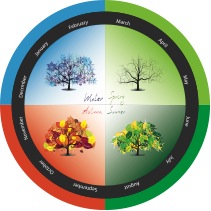
As a self-published author, deciding when to release your book can feel secondary to the bigger concerns of writing, editing, and marketing your masterpiece. And it certainly is. However, giving some thought to the best time of year to release your baby into the great, wide world can yield significant value in terms of sales. The first 6-8 months after you release your book is the time when to make the biggest splash, and timing it for a season that best suits your needs can help you maximize your profits in those months.

After researching how my fellow self-published authors have fared in selling books, below are the trends that I’ve noticed.

Spring
Spring is an average time of the year in terms of book sales for most self-published authors. However, it could be a great season for you as a self-published author if you choose to do heavy local promotion of your book during this time. Farmer’s markets and outdoor events can gather large crowds when the weather is at its best. Publishing and promoting your novel in the spring months could be a differentiator for you, especially if you are hoping to cultivate a local readership. For more tips on locally promoting your book, check out my post on the subject here.

Summer
The summer months are the slowest time when it comes to selling books in most genres. Whether it’s going on vacation for adults or getting through the grind of required summer reading for kids and young adults, readers simply don’t buy as many books as they do at other times of the year. Self-published authors shouldn’t be alarmed if they see a dip in sales in the summer. Depending on how often you publish, you could always delay your release until September, when book sales start to pick up.

Fall
After the slow months of summer, fall brings a welcome rejuvenation to selling books. Many readers buy seasonal books at this time, whether it’s spooky stories to get in the mood for Halloween or nonfiction cookbooks for Thanksgiving dinner. Personally, in the fall I find myself downloading Christmas stories for my e-reader to get me ready for the holiday season. If you have written something that ties in well to a seasonal activity, make sure to have your book ready on virtual shelves and heavily promoted in September and October.

Winter
The winter season is a great time for selling books. Before the holidays, many people purchase books as gifts. This can be a good time to sell hard copies of your book, since it’s harder to give an e-book as a present. After the holidays, readers are stocking up their e-readers with the stories they want to read in the new year.  And by the time February rolls around, romance authors often get a nice boost in readership. This is just speculation on my part, but I wouldn’t be surprised if the cold, wet weather also gives readers more time to search for and read books as well. This is an ideal time to get new readers hooked on your series.

The best option of all is to publish often. While there are seasonal fluctuations, successful self-published authors agree that publishing regularly is the key to a satisfied and growing fan base. If you can manage to publish 3-4 times a year, timing your releases based on seasonal fluctuations is secondary.

Do you have any successes or troubles that you think related to the time of year you published your book? If so, I’d love to hear what happened.

Deconstructing Hunger Games Heroine Katniss Everdeen

Hunger GamesA few years ago I stumbled upon a series that I knew was special. Before the movies, before the screaming fans, when I first read The Hunger Games by Suzanne Collins I knew I’d found something special. It wasn’t the premise that drew me in – I almost didn’t read the book because it sounded too gory for me – it was the heroine, Katniss Everdeen. She was tough but vulnerable, self-sacrificing but a survivor. I had already finished the first book of my own series, The Conjurors, and it made me rethink how to create a memorable, compelling YA fantasy heroine.

Below are some of the lessons that I took away from my analysis of Katniss.

Serious flaws make for a more compelling protagonist.
I think most authors know that their protagonist can’t be perfect. But at least for me, I find myself not wanting to make my heroine, Valerie, too flawed. I am afraid she’ll be unlikable. But analyzing Katniss taught me that this is a mistake. It is because Katniss can be angry, weak, and even lose track of her moral compass that I felt like she was so powerful. When she indulged her flaws, like when she got drunk and wound up in the fetal position in a basement after finding out she would be thrown into the hunger games for a second time, she felt human. When she overcame a flaw, like when she found the courage to inspire the rebels with her words in Mockingjay, it felt like a greater triumph because it didn’t come easily to her.

Protagonists don’t always have to take the moral high ground.
From the time in The Hunger Games when Katniss uses trackerjackers to attack her enemies to the end of Mockingjay when she assassinates the new president, Katniss doesn’t sit around over-analyzing the moral implications of every decision. She is a creature of action, which is part of what makes her so fascinating to watch. She isn’t like Superman, who refuses to kill. She is willing to do what it takes to survive and protect the ones she loves, even if her conscience is tortured by her decisions later.

Romance should not be the protagonist’s primary motivator.
I am willing to admit that I love romance, no matter what book I’m reading. Would I have objected to a few additional tender moments in The Hunger Games series? No. But I love that for Katniss, romance is always secondary to greater concerns. She’s not a girl to wallow and make all of her decisions based on the whims of her heart. Contrary to what I would have expected before reading this series, this makes the romantic triangle in the story more compelling, because we care more as readers what Katniss’ decision will be than she does herself. She’s too busy trying to save her district and fend off insanity.

When pushed past what she can stand, it’s okay to let your heroine break.
So many heroines and heroes come close to being broken by their experiences, but it’s not every day that you see a protagonist who truly is destroyed. The series is as much about Katniss rebuilding herself after extreme trauma as it is about breaking down in the first place. And though many of my friends were not fully satisfied with how the series ended, I thought it was courageous. It was the happiest ending possible for her character. PTSD doesn’t vanish overnight, it is a lifelong struggle. But I felt that Katniss didn’t give in to her tragedy, she fought to make a life for herself that was full.

Who are heroines and heroes in literature who have inspired your writing?

How to Name Your Protagonist

shutterstock_136700621When my husband and I decided to name our now-toddler Jacob, it was in the middle of the Twilight craze. You have my word that I didn’t choose his name because I’m team Jacob, though I have a feeling that I may field that question for the rest of my life. Really, Jacob is a name my husband has always loved and dreamed of naming his son some day. How could I say no to that? It was an easy choice.

Naming the protagonist of The Conjurors Series, Valerie Diaz, on the other hand, was much more difficult. I trolled websites, favorite books, and even newspapers for the right name. I wasn’t choosing a name that I loved, I was choosing a name that encapsulated the person I wanted her to be. I hoped that my final choice reflected her ethnic heritage, courage, and uniqueness. But as I start to think about the next series that I’ll be writing, it got me wondering if there were other ways to find the perfect name for my protagonist. Below are some of the techniques that fellow writers have found helpful, and a couple that I use myself when naming key characters.

Consider the regional origin of your protagonist and her key character traits.
A great place to start your name search is on a baby-naming website like Baby Names. What I love about this site is that you can search by region, if you’re looking to name your character something that would suit a particular part of the world, by popularity, or by meaning. This can also be a great place to finish your search for a character name. If you’ve found the perfect name that completely suits your character, it’s worth checking that the meaning isn’t something like “harbinger of doom”.

Borrow a name from history or literature and give it your own spin.
Whether it’s heroes from Greek mythology or your American history textbook, famous people’s names immediately come with an innate depth. But rather than simply calling your protagonist “Beowulf”, consider tweaking the name so that it sounds similar, but has its own twist.

Choose a name that inspires you personally.
Another, sometimes overlooked option is to name your protagonist for a particular hero or heroine in your life. Sometimes a name resonates with you for personal reasons, like the name of a teacher who inspired you. Even though the name may mean nothing to readers, you will unconsciously imbue your heroine with the good and bad qualities of the person they are named after, and can result in a more rounded protagonist.

Don’t pick a name that’s super hard to pronounce or remember.
As much as I enjoy unusual names, it is possible to go overboard. I’m a huge fan of The Chronicles of Prydain (especially The Black Cauldron) by Lloyd Alexander, but to this day I have no idea how to pronounce some of the names, like Eilonwy or Fflewddur Fflam. If I decide to write a rave review about a book where the characters have difficult names, it’s a huge deterrent if I have to go back and remind myself of how to spell the their names and remember who’s who.

Make sure the name makes sense for the setting you’ve chosen for your novel.
If you’re writing a medieval fantasy, for example, choose names that were popular at that point of history. It lends authenticity to your story. Also, don’t give all of the sub-characters unusual names if your protagonist has a name outside the norm. It dilutes the impact that you’re going for.

How did you name your protagonist? Any advice on other sources of inspiration for naming characters?

Author Interview: Alison Williams on Writing Historical Drama

The Black Hours book coverWell-researched historical fiction can have a profound impact on a reader, particularly when it touches on a subject as fascinating and appalling as the persecution of “witches” in England in the 17th century. Alison Williams tackles this difficult topic in her novel The Black Hours, evoking a dark, terrifying mood that made me appreciate yet again that I wasn’t born a few hundred years ago. Her story not only graphically details the blind paranoia of the times and the torture used on women accused of witchcraft, but also exposes the vulnerable powerlessness that women in general were exposed to at that time.

Alison shared her insights on researching and writing her novel, as well as what inspired her to explore the dark topic of witchcraft.

Tell us a little about yourself.

Alison WilliamsI live in Basingstoke, a town in Hampshire in the south of England. I originally trained as a journalist and met my husband at college. We have been married for 19 years and have two teenage children. I worked in education for several years, mainly with children with special needs. In my forties I decided that I needed to focus on my writing so took a Masters in Creative Writing. This really helped with my novel – part of The Black Hours was submitted in my final portfolio. I now write full-time as well as helping out with my husband’s PR business. I love to read – my favorite authors are Hilary Mantel and Elizabeth Kostova. I also like to watch movies (especially if they happen to be starring Johnny Depp or Ryan Gosling!). I also love music and like to see bands live whenever possible – in the last month I have seen Johnny Marr, Arctic Monkeys and Stereophonics. I’m happy to say that my kids often come with me – although usually because I’m paying for the tickets!

What was the original inspiration for your historical drama, The Black Hours?

I’ve always been extremely interested in history and, in particular, women’s history. I find it rather sad that a man like Matthew Hopkins <the villain of the novel> actually existed and did the awful things that he did, but that he is not really that well-known. In fact, a lot of people that have read The Black Hours think that I made him up! He was responsible for hundreds of deaths in England yet is hardly mentioned in our history books. Consequently, I really feel his victims have largely been forgotten – all too often they are just names on a list in a book or museum. We tend to forget that they were real people, with real lives, families, dreams, hopes and fears. What they suffered was dreadful and I really felt compelled to give them a voice. Although The Black Hours is fiction and Alice <the protagonist of the novel> never existed, the methods Matthew Hopkins uses in the novel are all methods actually used on real victims. I hope, in some small way, the novel pays tribute to those real victims.

You have a gift for creating a distinctly dark and desperate mood that permeates your novel. Did you consciously cultivate this tone, and if so, what were your techniques?

Thank you! I’m so glad that the desperation of the women comes across. I think that the tone comes naturally as a result of the subject matter. I felt that I had to try and put myself in their shoes (as much as a 21st century woman can) and try to understand and express how they must have been feeling as their world and everything they loved was threatened and ultimately destroyed. The biggest compliment I have had was from a reader who said that she was actually shouting at Matthew as she read because she felt as frustrated as Alice must have felt. That helplessness, frustration and despair, that feeling that there was nothing you could possibly do to help yourself out of this terrible situation, was what I imagined his real victims must have felt.

The Black Hours also explores the complex gender and power relationships at a particular point in history. Do you feel that your protagonist, Alice, is empowered by the end of your novel?

I have a real problem with some female characters in historical fiction who manage to fight against the odds and be independent, free and liberated. While I want Alice to be empowered and strong, which I think she is, I also want her to be realistic. I think it does a disservice to women of the past when modern day writers ignore the constraints that women lived under. By making them falsely brave or heroic I think they take away something from the everyday bravery that many, many women had to have in order to just survive. In 1647, Alice was empowered by simply being able to live alone and fend for herself.

Many of the readers of this blog are self published. Do you have any advice or marketing tips that have worked well for you?

I am learning all the time! I think that marketing is really tough because there are so many other books out there fighting for the readers’ attention. The best thing I have done is to develop a support network of other independent writers. I don’t think it helps to see other indie authors as the competition, rather I see my self-published colleagues as friends. I know that I can ask them for advice and support and in return I am happy to offer my own advice and support.

What is the most unusual thing that has ever inspired your writing?

I meet up with a group of four other writers once a month. We all write in different genres and have very different styles. We have, in the past, swapped genres and had a go at writing a piece in a genre we were really uncomfortable with. I got science fiction/fantasy! I can’t say I was exactly inspired, or that my attempt was very successful, but it was good to stretch my writing.

Is there anything else you’d like us to know about you?

I have to have total silence when I work. Any noise is instantly a complete distraction. Even the dog has learnt to be quiet in the day when I’m sat at my desk! It’s a shame because I’d love to have music on or listen to the radio, but if I do that then my focus is instantly on whatever song is playing and not on my writing. I must have a terrible attention span! Noise isn’t the only thing that distracts me – working from home there’s the chores, the telephone ringing, the doorbell and of course Facebook and Twitter to distract. What I’d really like is to have a house with enough land to build a little office at the bottom of the garden where I could hide away from everyone and everything and just get on!

Waiting to Self-Publish

A couple of months ago I decided to accept that I needed an official cover artist, and it was one of the best decisions I’ve made. Recently I also accepted that it was time to hire a professional editor as well. Coming to terms with spending the money was the first hurdle (along with accepting that I couldn’t do it all myself). But the second hurdle is the waiting.

The editor I’ve chosen is popular (with good reason) so I’ve had to put my plans for unrolling the rewritten first book in The Conjurors Series, along with the almost-finished second book until 2014. That means that the entire series might come out in the same year. It’s so hard to hold back my beautiful new cover and rewrites until I’m really ready to promote the series. It’s also hard to keep the momentum going to begin writing the third book in the series as well, which I planned to release in the late spring/early summer.

All newbie mistakes, I suspect. But it does leave me wondering what other surprises are in store for me in the beguiling world of self-publishing.

For those who have self-published a book, what unexpected hurdles did you run into?

5 Ways to Promote Your Self-Published Book Locally

shutterstock_156141578When researching how to market The Conjurors Series, I’ve read hundreds of articles on building a social media presence, leveraging Amazon, and where to list my novel as an e-book and a print book. But an excellent blog post by The Writing Teacher got me thinking about some local ways to get the word out when you self-publish. After all, you probably have an existing, strong network of people within their community who might be willing to help you promote your book if you ask. I did a little digging and found some useful ways to tap into your local community to market your book.

Talk to Nearby Libraries
Aside from agreeing to carry your book, many local libraries are eager to host readings by authors in the community. Many libraries welcome professional, high-quality books that are donated, and even have shelf space set aside for local authors. To increase your chances of being carried, have friends and family stop by the library and request your book. Libraries take requests seriously, and if your book is in demand they will be more likely to be open to displaying your book prominently. On a related note, I also read a recent blog post by Author Media that suggested having readings of your book at other places in your community, such as retirement communities, churches, and schools.

Pitch to Local Press
At first it seemed far-fetched to me that any local news channel, radio station or paper would consider covering a local writer. And it’s true that when you are completely unknown, it’s harder to get the attention of even your local media. But as you build buzz for your book by participating in events in your community, a well-crafted pitch may attract the attention of a reporter. Put together a high-quality media kit and you may be surprised by the response. For tips on what to include and how to put it together check out this post by The Alliance of Independent Authors.

Approach Local Businesses
Aside from independent bookstores in your community, many other businesses are open to selling books in a section of their store. Small grocers and magazine stands often have novels and other books available, and some even have sections for local authors. Consider offering these businesses a discount in order to entice them to carry your book. It is especially critical that your book be available at local vendors after promoting it with local press. You want people to see your book while it’s still top-of-mind for them.

Set Up a Booth at Local Events
Craft fairs, flea markets, county fairs and even farmer’s markets are all venues to get your face and book in the public eye. Don’t be afraid to list times for readings of excerpts of your story, or, if it’s nonfiction, possibly a demonstration or discussion on tips regarding a certain topic. Another option that is sure to attract crowds is a giveaway. Have potential readers put their name and contact information in a bowl, and having a drawing for free books at a designated time. That way, you can reach out to the entrants who didn’t win by offering an e-book version of your book at a reduced cost (or free).

Sponsor a Local Cause
Rather than teaming up with a random local cause, consider these two options. First, search for a cause that is related to your book. For example, I write YA fantasy, so I plan to look for organizations that support educating disadvantaged youth in the community. I can donate proceeds from my book to the cause and also give it away to the organization for the students they support to read. A second consideration is teaming up with another local group, like a band, who also support a cause. There is power in numbers, and by teaming up you’ll reach an expanded network of potential readers.

Have you ever promoted your book locally? If so, what techniques did you use and how successful were you?

The Curse of the Whiny Protagonist

shutterstock_148391531I’ll never forget reading book 5 of the Harry Potter series, Harry Potter and the Order of the Phoenix. Suddenly, sunny, kind little Harry was a brooding teenager. I remember thinking that I didn’t like him as much anymore. I understood that he was evolving as a character, and part of being a teenager is embracing angst – especially if you’ve just witnessed first-hand the death of a classmate. But his likeability factor plummeted. Of course, in spite of this change, this book is still incredible. I cried at the end. But it always stayed with me as the one book in the series where Harry didn’t feel like Harry.

So you’d think I learned a lesson from reading that, but after sending the second book in The Conjurors Series to beta readers, everyone said the same thing. My protagonist, Valerie, was too angst-ridden. And as I re-read and made edits, I realized they were right. Low self-esteem is part of her character, but it was over-the-top. Maybe massive low self-doubt is a natural part of being a teenage girl, but it didn’t read well in a heroine.

That’s when I realized that we don’t want to read about people who are exactly like everyone we meet in daily life. We want heroines who are exceptional, who, in spite of their flaws, rise above petty concerns and are capable of a depth of compassion or bravery or intelligence that we hope we are capable of, but we know most people aren’t. Maybe this isn’t true for every genre, but I truly believe the best YA fantasy books I’ve read all adhere to this idea in their protagonist. Harry Potter, Katniss Everdeen, Tris Prior – I could go on and on – all tap into the best versions of themselves under difficult circumstances.

That being said, I know this opinion isn’t one that everyone shares. The Twilight Series or even The Catcher in the Rye prove that you can be successful with a whiny protagonist who is written well. But I confess that these books are not on my favorites list. However, if you do love super-angsty protagonists, check out this Goodreads list on popular whiny protagonists – it gave me a good chuckle. It’s a definite counterpoint to the heroes I mentioned above, and proof that in the hands of a skilled writer, any protagonist can be compelling.

Of course, the danger is going to the opposite extreme and making protagonists too perfect – something that can be equally annoying. Finding that tricky balance with my own heroine is something that evolves with every chapter I write. Hopefully, after hundreds of hours of writing and edits, Valerie will come across as a real, but exceptional, teenage girl thrust into extraordinary circumstances who rises to the challenges she encounters.