Unknown's avatar

About conjurors

I am a YA fantasy author who started this blog to share the unusual places I find inspiration for my writing, and to discuss with other artists how they find their muses. My first book of The Conjurors series, Into the Dark, is now available on Amazon.

Five Terrifying Young Adult Fantasy Villains

Over the past few weeks I’ve been creating the backstory for the villain of my series, The Conjurors. I want him to be believable, compelling, and frightening. For inspiration, I looked to the masters of young adult fantasy and considered which villains I found most captivating. Below are my top five.

Lord Voldemort, Harry Potter, J.K. Rowling

VoldemortJ.K. Rowling may not be the first author to use Hitler as a model for her super villain, but she is the most creative, in my opinion. Voldemort’s obsession with the purity of the wizard race, combined with his sociopathic childhood, make him both creepy and intensely threatening. Throughout the series no one was safe – not even civilians or children. When he whipped out his wand, my palms would sweat for whoever was at the other end of it. And let’s not forget his snake, Nagini. I think I’d rather submit to “Avada Kedavra” than be eaten by that enormous monster.

Metatron, His Dark Materials, Philip Pullman

A power-mad angel with almost unlimited powers, Metatron feels undefeatable in the His Dark Materials series. He uses the language of religion to create a dictatorship from heaven, where he can control human’s lives like puppets. Perhaps most chilling of all, he is even more powerful than The Authority, who is god in the series. Throughout the books, I found myself wondering how he could ever be taken down – but it was by his own weakness in the end, not someone more powerful than himself. My one gripe was that the hero and heroine of the story, both children, weren’t the ones to lead him to his doom.

Galbatorix, The Inheritance Cycle, Christopher Paolini
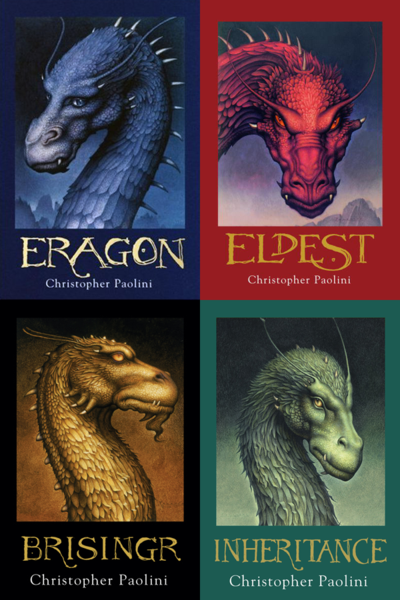
InheritanceCycleCoversUsing the souls of dead dragons to power his magic? Yikes! I have to give Paolini credit for finding one of the most original and sinister ways for a villain to derive his power. Galbatorix is absent for much of the series, but he is always talked about. This makes him more intimidating than if we were encountering him around every corner. And when Eragon does finally encounter the villain of the series, he doesn’t disappoint – he can possess people and, like Metatron, has to defeat himself because he is too powerful to be destroyed by anyone else.

Society, The Giver Quartet, Lois Lowry
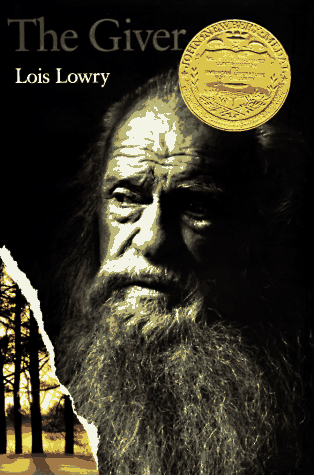
TheGiverThe Giver was one of the most fascinating books that I read when I was younger, and Lowry has recently finished the series in 2012 with the final book, Son. In this series, it isn’t one villain who acts as the antagonist of the series, but rather society as a whole. The mob mentality of killing off those who are weak, and a conscious decision to shut off emotions, leads to very cold and clinical assessments of who should live and die. It’s a world where babies who cry too much are killed, having a disability can lead to execution, and it is up to children to be the moral compass for a society that has no idea that it is out of control. In this way the villain of the series is like the hydra – one head is cut off only to be replaced by two more.

Neferet, House of Night, P.C. Cast and Kristin Cast

The House of Night series achieved something difficult when they created Neferet, a beautiful, powerful and charismatic vampyre who wants to instigate a war with humans. Part of Neferet’s appeal comes from the fact that she is so likeable at times – for a good part of the series you hope she can be turned around. She also has a great backstory that really makes you feel for her. I thoroughly enjoy a villain who I can sympathize with and isn’t pure evil. When the hero or heroine has to defeat someone they care about on some level, the stakes seem higher.

Did I miss your favorite YA fantasy villain?

Falling in Love on the Page

Picture1I’m writing the second book in my series, The Conjurors, and my main character is falling in love. Writing this in a way that feels real and conveys the power and passion of love when you’re 16 has been exceptionally hard for me to do well. If I keep it too minimal, readers won’t have an emotional investment in the relationship. But take it over the top, and it starts to feel like a cheesy romance novel.

Not to be controversial, but my one gripe with J.K. Rowling‘s Harry Potter (of which I’m a HUGE fan) was that I never felt invested in Harry and Ginny. Hermione and Ron, I was totally rooting for. But somehow I always felt like Harry deserved a more compelling love story.

At the other extreme, Stephanie Meyer‘s Twilight series hit a nerve with YA girls for the romance, but for the rest of us who were looking for more substance to the world and the action surrounding that story, the series was disappointing.

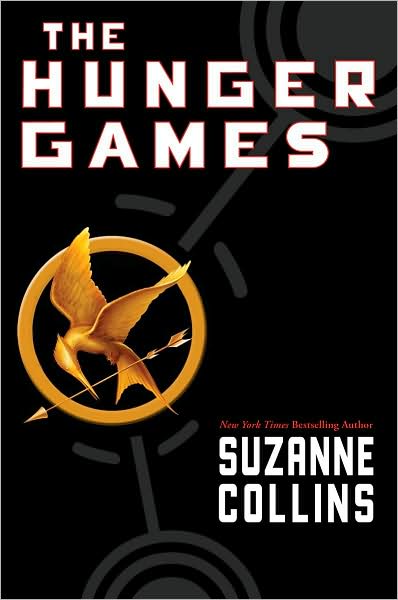
hungergamesSo how do writers find the right balance? I think that The Hunger Games by Suzanne Collins did a great job of weaving a dynamic love triangle with a gripping story. It gave the series an emotional center that made the stakes higher and the consequences more poignant.

What YA books do you think have done an exceptional job with romance?

A Look Back at Children’s Fantasy Classics

Writing for a younger audience as an adult is a tricky business. Granted, I still feel like an 11-year-old kid on the inside, but actual 11 year olds tell me that I am, in fact, a grown woman who should probably not hog the swings at the park. And in my writing, as much as I try to channel my inner child, I know that sometimes I may be missing some of the intense wonder and possibility that most people only feel until a certain age.

Wrinkle in TimeWhen that happens I think back to the fantasy and sci-fi books that drew me in as a child, the ones I read over and over. One series that I loved was A Wrinkle in Time by Madeleine L’Engle. I read them again and again through the years, and every time I would get something new. As an eight year old, I struggled to wrap my brain around the concept but was fascinated by the raw emotions of Meg and her family. At 12 I only cared about the romance between Meg and Calvin. And in high school I was finally able to marvel at the complexity of the world and the characters.

I also loved The Girl with the Silver Eyes by Willo Davis Roberts, where the main character moves things with her mind. She was an outsider (like me) who found friends and mastered her powers to do cool things. I remember logging serious time staring at objects and trying to move them with the power of my thoughts, or trying to have conversations with my friends telepathically.

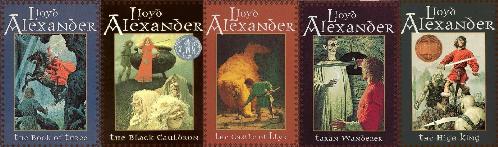
The series on my shelf that had the most worn spines was The Chronicles of Prydain by Lloyd Alexander. The main character was a boy, Taran, but I could completely relate to him. And the world that Alexander created was so rich that you could practically smell the pig pen that Taran had to keep clean. To this day just seeing the covers reminds me of rainy days huddled by a window with a book and nights with a flashlight under the blanket.

PrydainI could go on and on. But these blasts from my past always help me realize that a great fantasy or sci-fi is less about a cool concept or a fascinating world, and more about a character who feels real to a kid. The character can be as smart or powerful as an adult, but they must approach the world with curiosity and hope, and believe that they still have the power to make a difference, even if it is in a small way. And when they do, every kid who reads that story feels for a minute like they might be special too.

What are the books that you read as a child that still inspire you now?

What’s your writing playlist?

shutterstock_121057780I love playing music while I’m intensively writing. Years ago when I wrote a Christmas movie, I blared Christmas carols for four months straight. To this day when I hear certain Christmas songs I start having the itch to grab a pen.

But when I was writing Into the Dark, I received a different kind of inspiration from one song on my playlist, Viva la Vida by Coldplay. The song is about someone who falls from power, and the mood of the song subconsciously became associated with one of the characters I was writing. Suddenly his personality was just like the song, bittersweet and self-reflective. I didn’t completely understand what I was doing until I was listening to the song in the car one day and imagining key scenes from the character’s life in association with different verses.

Realizing how affected I am by what I’m listening to, I make very specific, tailored playlists based on which scenes I’m writing. Sometimes I have to make purely instrumental playlists so the lyrics don’t distract me.

What’s your writing playlist?

Vote on Cover Art for Into the Dark

The time has come to refresh the cover image for my young adult fantasy novel, Into the Dark, which is the first book in The Conjurors series. Below are the three options that I am considering. Which image would make you want to pick up my book and learn more?

Option A

Option A

Option B

Option B

Option C

Option C

Thank you for your vote!

Attempting to Channel the Bard

NEW121I was 13 when I discovered William Shakespeare’s A Midsummer Night’s Dream, and it changed my life. I had always loved writing, but when I encountered his words and saw how poetry and fantasy could merge together, I knew I found something special. It’s been almost two decades since then, but Shakespeare remains the biggest inspiration in my life. The best thing about Shakespeare is that you never run out of angles to analyze, from word choice to character development to plot.

When I developed the Globe, which is the world in my YA fantasy series The Conjurors, I named most of the major countries after locations from my favorite Shakespeare plays. The atmosphere of the play that the location came from inspired how I felt about the people who lived there.

Arden is the capital of the Globe, named after the forest in As You Like It. It is the home of my main character, Valerie, when she travels to the Globe from Earth. In As You Like It, Arden is a forest, a place of possibility, where the rules that apply to the civilized world can be bent. It is a place of art and philosophy and love, which is why I made it the beating heart of the Globe.

The mountains of Dunsinane are where the villain of the story, Reaper, lurks. Dunsinane is where much of the action in Macbeth occurs, and that play has such a heavy darkness to it that I felt it reflected the depth of evil that Reaper is capable of. To me, just hearing the name “Dunsinane” sends chills down my back, and I think of ruthless ambition and decaying morality.

Other countries inShakespeareclude Messina, from Much Ado About Nothing, a land where the people have forbidden the use of magic, and Elsinore, from Hamlet, where royalty and betrayal are the obsessions of the people.

Using these plays as inspiration gives me a sense of place when the characters in my stories travel from land to land. The countries are strongly differentiated in my mind, which makes it easier to create cultures that are unique, but somehow fit together enough that it is realistic that they could all inhabit the same world.

What makes a fantasy world feel real to you?

Let the plotting begin…

A course more promising / Than a wild dedication of yourselves / To unpathed waters, undreamed shores ~William Shakespeare Winter’s Tale, Act IV, Scene 4

Life is never more interesting for me than when I’m plotting out a novel. Suddenly, everything I encounter feels like inspiration. Watching my husband beat a video game, a news article on an exciting archeological dig in Egypt, or a friend’s work horror story all fill my mind like puzzle pieces begging to be put together to show me a bigger picture.

The characters come first – a name, a face, a mannerism. Soon I’m wondering what advice they’d give me about a coworker who is trying to sabotage me, or thinking about how they would react if they woke up in a completely new world. Would they panic? Or would they relish the adventure?

Next, I sense connections between the characters, how their personalities fit together. Romance and rivalries start to emerge, and I find myself empathizing with one character above the others. I’m rooting for that person to win and be happy, logically aware I’m rooting for a figment of my own imagination, but emotionally invested anyway.

Last comes the action. This is my favorite part. On the outside, I’m living my life as usual, driving to work, sitting in meetings, cooking dinner. But as my body goes through the motions, I’m really watching a movie unfold in my mind. The movie stops and starts, rewinds and zips to the end, only to wind up back where I left off. I start to feel like I’m living two lives, one in the real world and one in my head, but I know one thing for sure. Life is thrilling and full of possibilities.

When you are writing a new story, how does your creative process begin?